Traditional UPS systems still play an important role, but many operators are now evaluating hybrid strategies that combine UPS with newer technologies. Getty Images. For decades, uninterruptible power supply (UPS) systems have been an essential component of most data centers.
By providing short-term backup power and helping regulate voltage to servers and other IT equipment, UPS units have played a key role in maintaining uptime.. But the power landscape is changing. A growing number of alternatives to traditional UPS devices are emerging, and many promise advantages such as longer runtimes, lower maintenance requirements, or better space efficiency..
Here is a look at several emerging UPS alternatives, along with guidance on when it may make sense for data centers to move away from conventional UPS systems – or adopt a hybrid strategy that combines newer technologies with tried-and-true UPS infrastructure.. Why Traditional UPS Strategies Are Under Pressure.
Before exploring specific alternatives, it is worth considering why UPS systems may no longer be the ideal answer for every data center’s power protection and backup needs.. Related:The UPS Is Uninterruptible by Design. Its Future Is Not..
One major factor is the rise in data center power consumption. The more power a facility draws during normal operations, the more UPS capacity it needs to support critical loads during an outage. Because UPS systems can be expensive to deploy and often require battery replacements every 3 to 5 years, operators experiencing rapid power growth may be motivated to evaluate alternatives..
The increasing use of on-site power generation is another driver. As more data centers add generation assets to supplement or reduce reliance on the grid, the preferred response to a power disruption may be an immediate transfer to on-site generation rather than depending solely on a centralized UPS to bridge the gap.
Some new power protection architectures are designed specifically to support that model.. Alternatives to Traditional UPS Systems. Data center operators that decide conventional UPS systems are no longer the best fit have several options to consider..
Battery Energy Storage Systems Extend Backup Duration. Battery energy storage systems (BESS) use high-capacity batteries to store large amounts of electricity. Today, they are most commonly deployed to capture energy from renewable sources such as solar or wind for later use.
But they can also play a role in data center backup power strategies.. BESS and UPS systems both rely on stored battery power, but BESS systems are typically designed on a much larger scale. That distinction matters because a BESS deployment can provide backup power for much longer periods than a traditional UPS.
While many UPS systems are designed to bridge only 10 to 15 minutes, BESS can support loads for hours, depending on system size and configuration.. Related:Hydrogen’s Hurdles, Fuel Cells’ Rise in Data Center Power. The tradeoff is cost.
BESS generally requires a higher upfront investment and more complex integration. However, for data centers that experience longer outages, want to store renewable energy, or are building more flexible on-site energy strategies, BESS can be an attractive alternative or complement to UPS infrastructure..
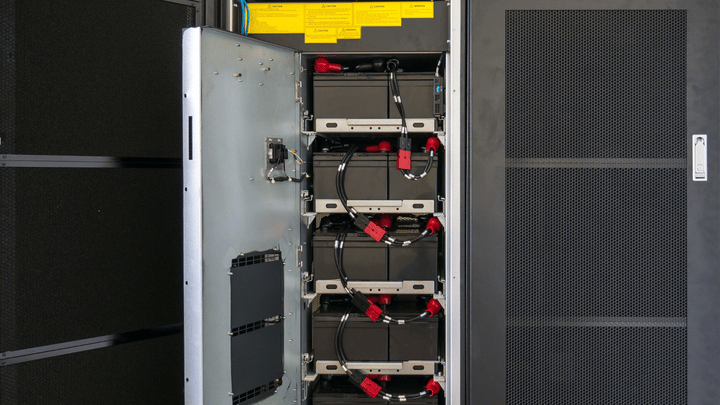
Rack-Level Batteries Save Space and Localize Protection. Most data center UPS systems are centralized, supporting dozens or even hundreds of servers from a single installation. That model is relatively straightforward, but it also consumes valuable floor space that could otherwise be used to increase density and capacity..
Rack-level batteries address that challenge by placing backup power directly inside the rack. In effect, they provide localized power protection without requiring the same dedicated floor footprint as a large, centralized UPS. They can also help reduce the heat concentration associated with larger battery rooms or UPS installations..
Rack-level batteries share some of the same limitations as traditional UPS systems, including periodic replacement and lifecycle management. Buffer modules offer space-saving benefits at a time when many operators need to maximize capacity within existing facilities. They can provide up to 20 seconds of coverage, making them a potential alternative to traditional UPS systems in certain environments.
On-site microgrids are becoming more common, reducing dependence on traditional UPS architecture and improving resiliency. However, power conditioning and ride-through protection are still necessary to protect IT equipment from voltage fluctuations and short transfer gaps. A hybrid power strategy, combining UPS systems with newer technologies like rack-level batteries, buffer modules, and BESS, can deliver better economics and resiliency for many data centers.
The future of backup power will be more distributed, flexible, and aligned with broader energy strategy.