Trending
Sponsored: Belimo strengthens global data center strategy with new Experience Center in the Americas Bonus Features – October 25, 2026 – 40% of orgs say identity authentication difficulties delay patient care, Epic introduces Connectors for third-party apps, plus 34 more stories Georgia’s Silk Cloud deploys Nvidia Blackwell Ultra GPUs ZTE unveils data center module designed for AI workloads Fewer Care Delays, More Cost Savings: Nationwide Diagnostic Image Exchange Is Possible With TEFCA Weekly Roundup – October 24, 2026 DCD Studio: AI’s power problem with Varun Sivaram, Emerald AI G42 signs MoU for AI infrastructure in Greece Tesla appoints new head of energy programs Rethinking coolant selection for modern and future cooling systems Core Stack JV adds more data centers to €1bn Italy network Microsoft introduces new sovereignty tools across public and private cloud O2, Nokia complete AI RAN deployment at O2’s Giga Site in London Paddington The power behind AI: Data centers drive the demand for qualified electricians Crown Castle bullish on carrier spectrum deployment, says it can support SpaceX’s terrestrial dreams

How to Design for Failures

It is impossible to build a failure-proof software system. Sure, a system can go through its lifecycle without any failures. But you can’t provide a guarantee that it will never fail.

You might think that if we write perfect code, we can get rid of failures. But writing correct application code is just one part of the problem. Even perfectly written software depends on a physical computer, power availability, working storage, and so on. If the machine loses power, the software will fail no matter how good it is.

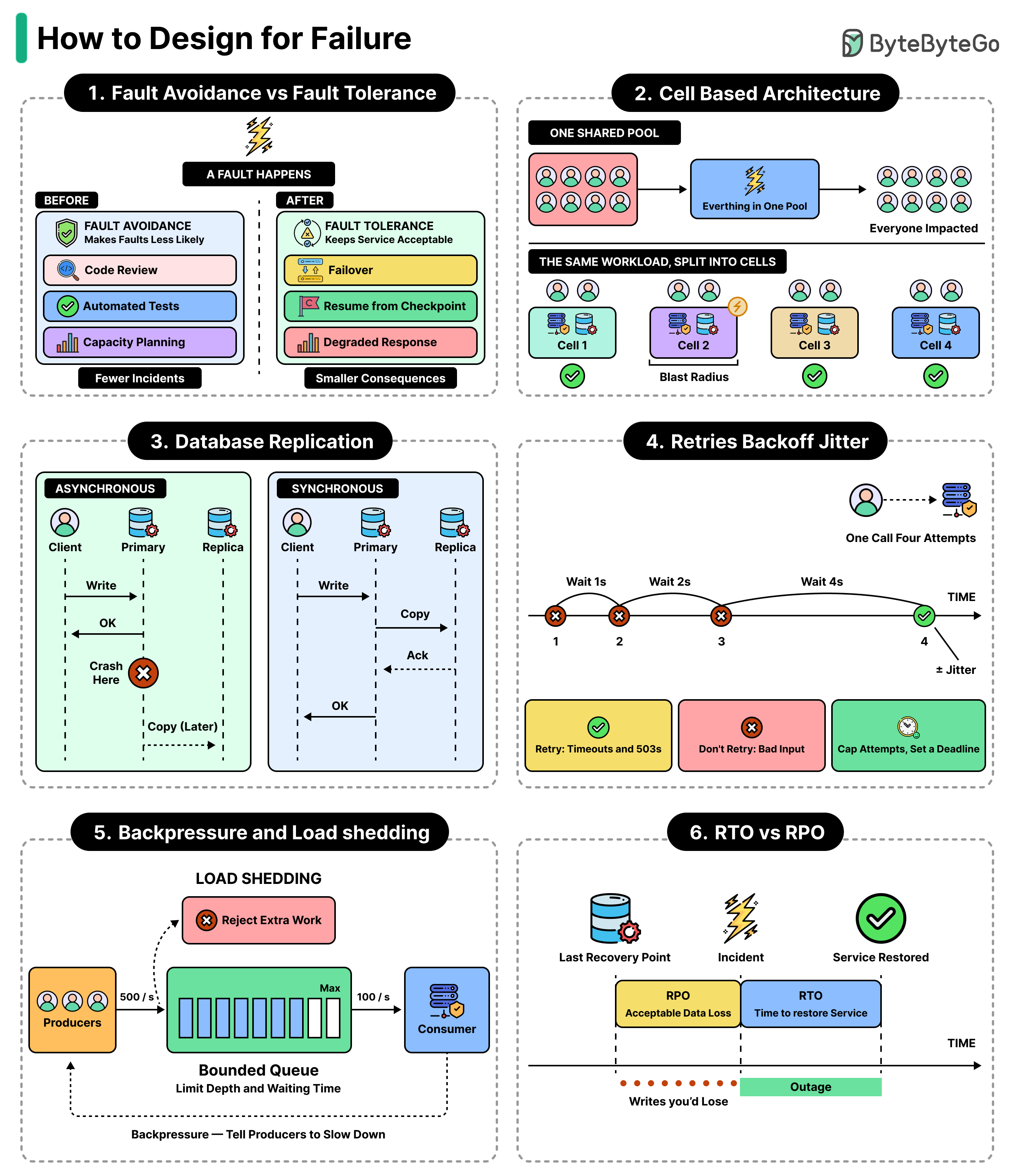
Therefore, you have to design for failure. This means deciding in advance how a system should behave when some of its parts are not working correctly. In this article, we’ll look at the various strategies that can help developers deal with failures in their systems. Here’s what we will cover:

  • Why adopt an “assume everything breaks” mindset

  • Avoiding faults vs tolerating faults

  • How to figure out the scope of a failure

  • How to reduce the impact of a failure

  • How to handle failures while running the system correctly

  • How to measure recovery from failures

 

Join the conversation

Your email address will not be published. Required fields are marked *