
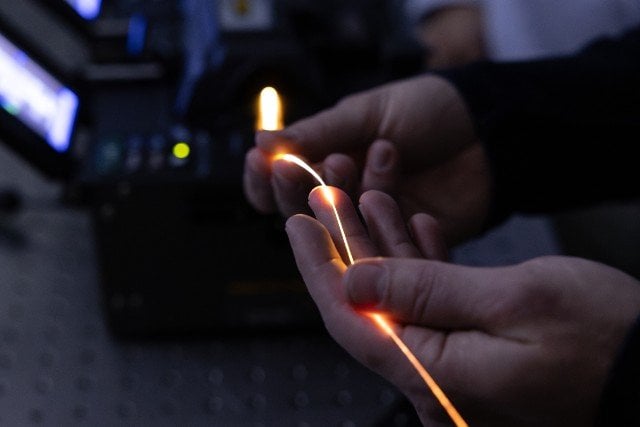
Italian optical cable manufacturer Prysmian and Relativity Networks have this week deployed what both claim to be their highest-density hollow-core fiber cable to date.
The announcement builds on a partnership signed between the companies last year for the mass production of hollow-core optical fiber (HCF) and cabling.
According to Prysmian, the company successfully completed high-density cable deployment tests in collaboration with Dura-Line, a manufacturer of high-density polyethylene (HDPE) conduit solutions.
Testing was carried out at Dura-Line’s flagship test facility in Clinton, Tennessee. Prysmian noted that the tests confirmed the reliable installation of a high-density cable incorporating Relativity Networks’ ChronoCore hollow core fibers at jetting speeds of up to 350 ft/min.
Prysmian notes that this demo was important as it shows that the technology is ready for real-world deployment and is a step forward for the development of AI optical infrastructure and data center networks.
The cable is based on Prysmian’s Sirocco architecture and incorporates Relativity Network’s ChronoCore hollow core fibers.
Prysmian noted that the cable “delivers the expected optical performance while supporting the development of next-generation low-latency data center infrastructure.”
Hollow core fiber is seen as a transformational upgrade from traditional fiber due to its design. HCF features an air-filled center channel that is surrounded by a ring of glass tubes, akin to a honeycomb pattern. The design allows for higher capacity with minimized chromatic dispersion, while light is able to travel significantly faster.
Traditional fiber-optic cables have typically limited data centers to within 60 kilometers (37 miles) of power providers – or to one another – due to latency constraints, however, HCF extends this range to 90 kilometers (56 miles).
The technology is seen as important due to its extended reach, lower latency, and higher bandwidth. Jason Eichenholz, founder and CEO, Relativity Networks, has previously told DCD that there’s huge demand for this technology from hyperscalers.
Indeed, that was one of the key reasons why Prysmian and Relativity signed their HCF production agreement last year, in order to support the demands of AI data center operators.
“This milestone comes just 15 months after Prysmian’s partnership with Relativity Networks to industrialize hollow core fiber—and reflects Prysmian’s long-standing leadership in innovation,” said Srinivas Siripurapu, chief innovation and sustainability officer, Prysmian.
“We worked closely with Relativity Networks and Dura-Line to achieve this important industry milestone to showcase the scalability and technological readiness of this innovative digital infrastructure.”
Rodrigo Amezcua Correa, CTO, Relativity Networks added: “A breakthrough fiber technology only matters if it can be manufactured, cabled, and deployed at scale – and this milestone proves that it can. Seeing ChronoCore HCF produced and installed while delivering the performance it was designed for – to enable the next generation of distributed AI – marks the transition from innovation to infrastructure.”
Providing a further update of the partnership between the two, Prysmian said it’s already scaling production of Relativity Network’s hollow core fiber, including investments in its Eindhoven facility in the Netherlands, while its Claremont, North Carolina, plant has successfully manufactured the cable with 24 hollow core fibers in a 10mm diameter cable.
It comes as Prysmian penned an agreement worth €5.5 billion ($6.29bn) this week with Koch-owned Molex to supply optical cables for deployment inside data centers.
The company said the deal with Molex is part of an overall set of new agreements and commercial initiatives with hyperscalers and data center infrastructure providers that are expected to bring in an additional cumulative value of more than €10bn ($11.41bn) on an incremental basis up to 2035, versus the 2025 baseline.
More in Networking


More in Telecoms & 5G