What You Should Know
- Basalt Health, an AI-driven platform automating patient transitions and admissions into post-acute care facilities, raises $20M Series A financing round, bringing its cumulative capital raised to $24.5M.
- The financing was led by return investor New Enterprise Associates (NEA), with continued participation from healthcare venture funds Frist Cressey Ventures (FCV) and 25m Health (the healthcare venture studio of 25madison, backed by Apollo Global Management).
- The technology tackles a massive operational bottleneck: approximately 14 million patients enter post-acute care annually, with hospital case managers traditionally faxing 70-page clinical dossiers to an average of 6.6 facilities per placement, contributing to an estimated $17 billion in avoidable annual readmission expenses.
- The platform is scaling across 111 total enterprise markets by the end of 2026, encompassing 49 additional Lifepoint Health markets and 62 hospitals within ScionHealth, where it will process incoming referrals across a network of more than 6,000 clinicians.
Ingesting Unstructured Packets and Accelerating Intake Velocity
Founded in 2024 by CEO Ben Hackett (a former executive at Accolade), Basalt acts as an intelligent automation layer for post-acute intake:
- Multi-Modal Referral Ingestion: Automatically ingests and parses incoming referrals regardless of format—whether arriving via legacy fax, secure web portals, or direct EHR interfaces.
- Algorithmic Clinical & Payer Matching: Evaluates unstructured patient packets against receiving facility clinical admission criteria, staffing competencies, bed availability, and payer authorization requirements in real time to reach defensible placement decisions.
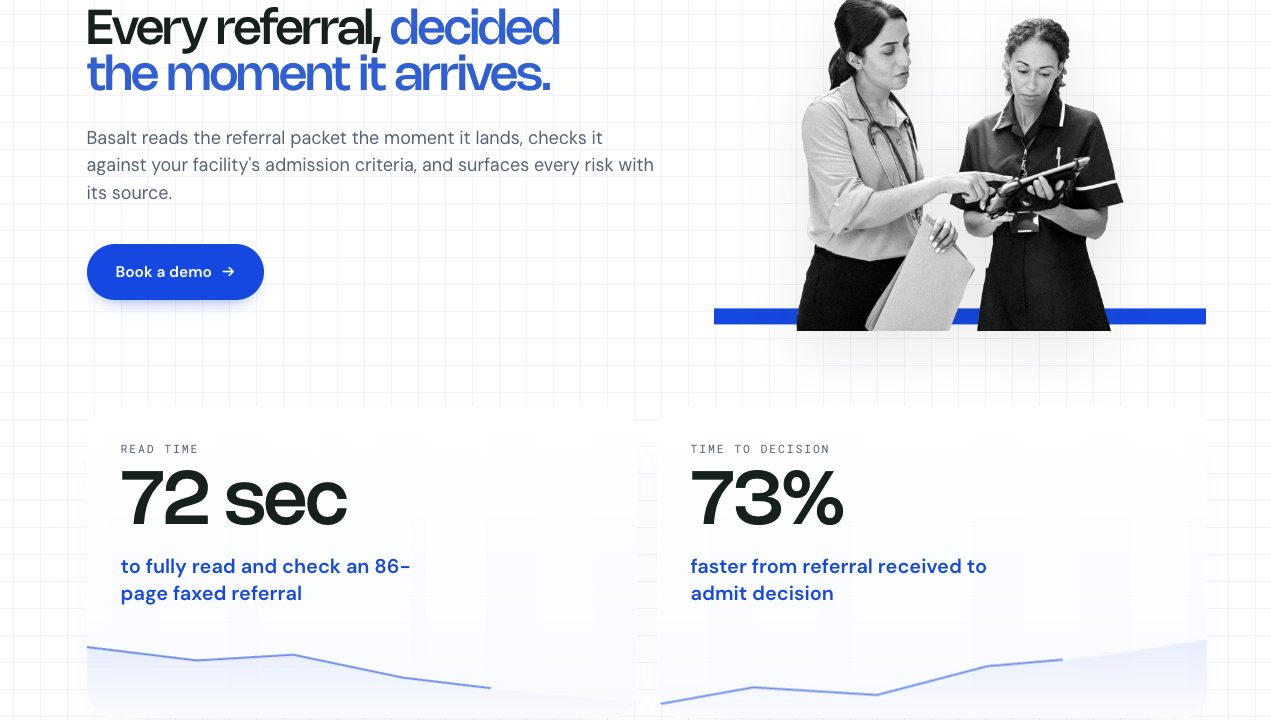
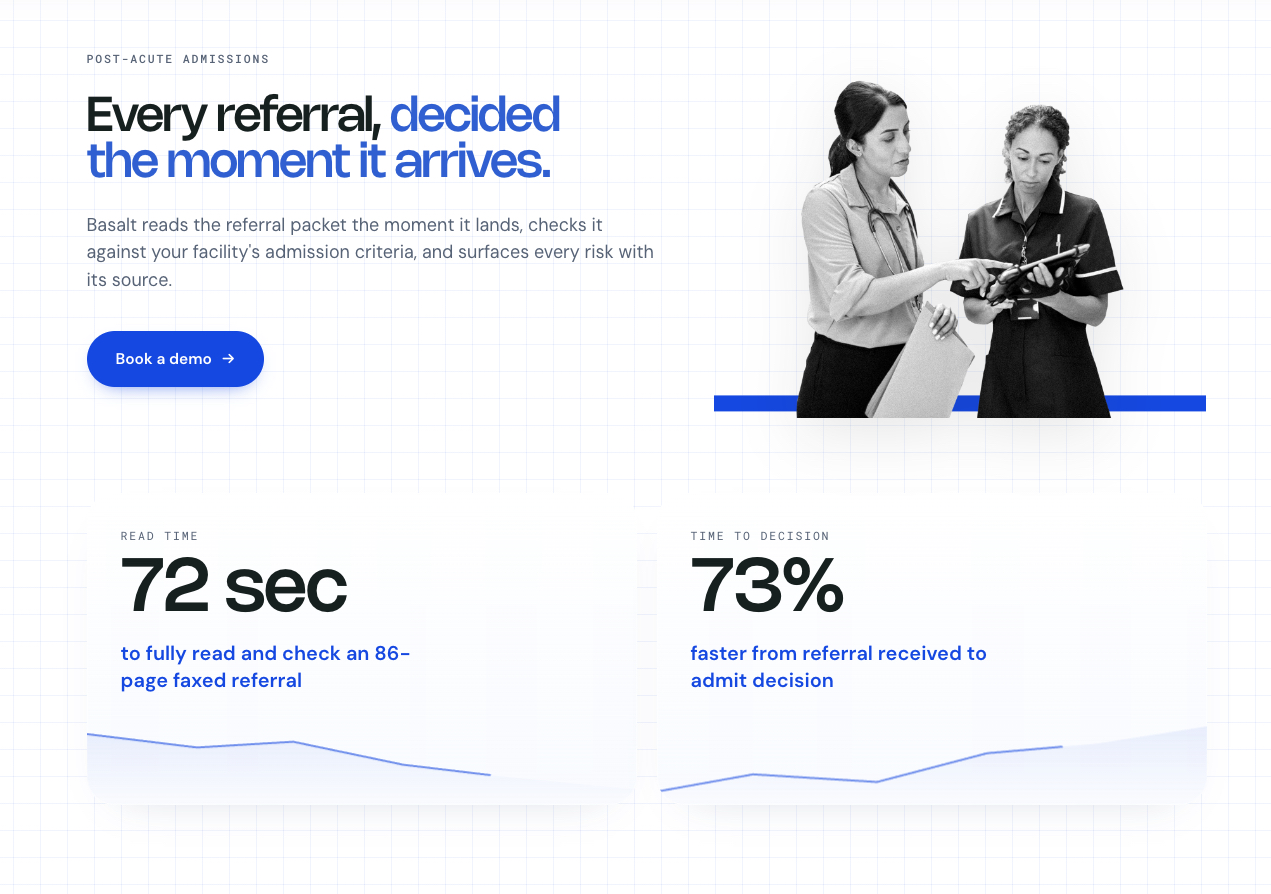
- Demonstrated Intake Velocity: At enterprise health system partner Lifepoint Health, Basalt reduced median chart processing time by 86%, dropping review turnaround from 8.5 minutes down to 1.2 minutes per referral.
Commercial Expansion Across 111 Hospital Markets
The financing directly underwrites large-scale enterprise deployments across acute and post-acute hospital operators by the close of 2026:
- ScionHealth Enterprise Rollout: Scaling across 62 ScionHealth hospitals nationwide by December 2026, where the platform will manage all incoming post-acute referrals across a network of over 6,000 practitioners.
- Lifepoint Health Expansion: Expanding beyond its initial pilot facilities into 49 additional Lifepoint Health markets by year-end.
- Product Roadmap: Proceed allocations will fund platform expansion beyond admissions intake into acute discharge planning, downstream payer prior authorization workflows, and benefits coordination.
Solving the Downstream Hospital Throughput Crisis
The enterprise adoption of Basalt highlights an acute operational reality: acute-care hospitals cannot resolve emergency department boarding, surgical backlog, or bed-capacity constraints without fixing the post-acute exit door.
While legacy care coordination software simply digitized fax transmission into web-based document pools, it failed to eliminate the manual cognitive labor required to read lengthy charts and evaluate clinical suitability. By acting as an automated “system of action” that ingests messy, unstructured documentation and executes preliminary placement criteria, Basalt enables post-acute providers to accept appropriate admissions in minutes rather than hours—accelerating throughput for acute health systems while maximizing post-acute bed occupancy.