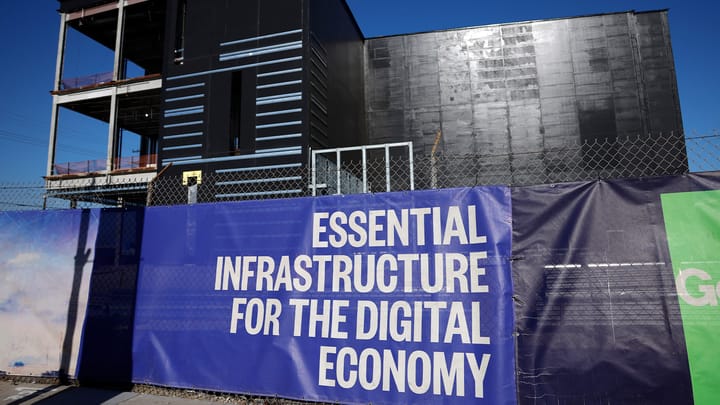
IDCA CEO Calls for Global Consensus on Data Center Development. 5 Min Read. A data center under construction in July 2026 in Vernon, California.
A surge in demand for AI infrastructure is fueling a boom in data centers across the country and around the globe.Photo by Mario Tama/Getty Images. The data center industry needs a global consensus on how digital infrastructure is deployed or risks slowing the expansion needed to support the AI era, according to Mehdi Paryavi, founder and CEO of the International Data Center Authority (IDCA)..
Speaking to Data Center Knowledge ahead of the publication of the organization’s latest industry report today (July 15), Paryavi said fragmented national approaches to permitting, energy policy, and infrastructure planning threaten to become a major obstacle to continued AI-driven growth.. The CEO’s comments come as electricity demand from data centers continues to accelerate.
According to the IDCA, digital infrastructure facilities now consume nearly 68 GW of electricity worldwide – around 1.9% of global generation and 17% more than a year ago. In the US, the organization estimates that data centers account for 26.7 GW of demand, or roughly 6% of the national grid..
Related:New York Data Center Moratorium: State Pauses Projects Over 50 MW. Those figures broadly align with projections from the Electric Power Research Institute (EPRI), which said earlier this year that data centers currently consume around 5% of US electricity and could account for 9% to 17% by 2030..
Against that backdrop, the IDCA’s Global Energy Report examines how governments and operators can balance AI-driven demand with grid constraints, sustainability goals, and community concerns.. Grid Constraints Reshape Development. Among its key findings, the report warns that grid constraints have become critical in at least 12 major data center markets, with moratoriums or restrictions in countries including the US, Singapore, the Netherlands, Germany, South Korea, Chile, and Mexico.
It also argues that while liquid cooling is easing pressure on water supplies, it is increasing demand on already strained electricity grids.. The IDCA estimates that around 13% of US data center electricity is consumed by “zombie” applications – idle or underutilized workloads – representing more than 3 GW of potentially recoverable capacity.
The report also contends that renewable energy alone will not be sufficient to meet accelerating AI demand, pointing instead to technologies such as small modular reactors (SMRs), hydrogen fuel cells, liquefied natural gas (LNG), and battery energy storage systems (BESS) as bridging solutions.. While the report concludes there is no one-size-fits-all approach to digital infrastructure, Paryavi said the industry ultimately needs a common global framework to avoid increasingly fragmented approaches to data center development..
Related:IDCA: Data Centers Hit 67.7 GW as Policy Pushback Mounts. “Without such consensus, the fragmented approach will put a halt to the progress of the digital world,” he told Data Center Knowledge. “Imagine if IP address meant something else every time an internet packet crossed a border, or if kW meant a different notation in different nations than its current meaning.”.
He added: “We as human beings have progressed and evolved because we have reached consensus at every turn of every evolution. The AI era and the data center evolution require a universal coherence to global standards that are both inclusive and robust.”. Behind-the-Meter Power.
As more markets face power shortages and permitting delays, the report advocates sustainable energy alongside “behind-the-meter” and “bring your own power” approaches that reduce reliance on traditional utility grid connections.. Asked how operators can unlock constrained markets, Paryavi said governments first need to rethink national energy planning..
“The first and foremost unlocking mechanism for nations is to realize that their infrastructure, including their national grid, as well as the planned pipeline of production they have projected, are both obsolete and irrelevant,” he said.. “What digital hubs, driven by the AI demand, have sparked is an awakening for governments to realize that their national grids are simply inadequate for the future that’s before them.
So, a) everyone must embark on reinventing themselves and their energy security plans to ensure that they stay in the race, and b) in the interim, behind-the-meter power, as well as collaborating with neighboring provinces or countries that have excess power, are the only solutions for unlocking such frozen markets.”. Related:Can Growing Community Backlash Quiet the AI Data Center Boom?.
Honeywell reached a similar conclusion in a recent white paper developed with the Massachusetts Institute of Technology (MIT), arguing that behind-the-meter generation will become a core design consideration for AI data centers rather than simply a backup strategy.. “AI campuses are increasingly being developed as integrated energy environments, where on-site generation, energy storage, and grid interaction operate as a coordinated system rather than separate elements,” report author Carlos Guillen, director of integrated offerings for power infrastructure and data center solutions at Honeywell, told Data Center Knowledge..
“The rapid growth of AI workloads and the inability of grids to scale at the same pace are driving developers to adopt on-site generation and energy buffering as part of their foundational infrastructure. As a result, behind-the-meter power is becoming an increasingly important pathway to securing reliable power availability, accelerating deployment timelines, and supporting the resilience required for next-generation AI operations.”.
No Sign of Slowing Demand. While some industry observers have suggested that growth could decline as models become more efficient, Paryavi said a slowdown in new data center development is unlikely any time soon.. “We don’t foresee a saturation point,” he said.
“The data center industry has already outgrown traditional data center designs and IT workloads. The situation today is that companies feel they simply cannot build too many data centers to meet the demand.”. He added that large hyperscalers are building roughly 70% of the pipeline footprint, and large industry developers, colocation providers, and other hosts are building as quickly as they can..
Building Community Value Through Regenerative Infrastructure. Beyond energy supply, the IDCA report argues that data centers should increasingly function as regenerative infrastructure, delivering tangible benefits to surrounding communities through initiatives such as waste heat reuse..
The paper highlights several projects already underway, including Microsoft’s partnership with Fortum in Finland to provide district heating for around 250,000 people, Meta’s district heating initiatives in Denmark, Amazon’s contribution to Ireland’s Tallaght District Heating Scheme, and plans in London to heat more than 9,000 homes using waste heat from nearby data centers.. As the report concludes: “Rather than operating solely as large-scale resource consumers, facilities are increasingly being designed to integrate with local infrastructure systems.
This includes the capture and reuse of waste heat for district energy applications.”. Read more about:. About the Author