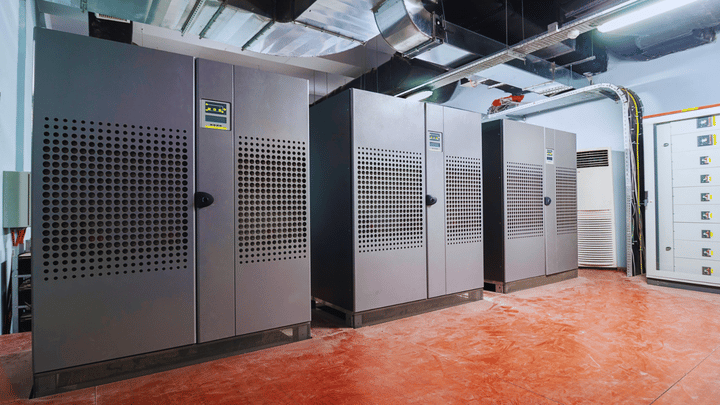
The uninterruptible power supply (UPS) has long been a critical element in the data center power train, providing both power conditioning and resiliency. That central role is increasingly under question as infrastructure evolves at both ends of the power chain. On the load side, AI-driven densification is reshaping facilities from the rack outward.
On the grid side, greater integration of renewables, microgrids, and on-site generation is changing the profile of power delivered to data centers.
While the UPS remains vital to ensuring uptime, it also introduces risks and can contribute to downtime. According to the Uptime Institute’s Annual Outage Analysis 2026, power-related issues caused more than one in five IT service outages reported over the past three years.
Within those power-related incidents, UPS failures were the leading cause, accounting for 39%, ahead of transfer switch failures (34%) and generator failures (28%).
Related:Hydrogen’s Hurdles, Fuel Cells’ Rise in Data Center Power
The same Uptime Institute Intelligence research points to a fire risk from UPS batteries: “The frequency of major fires at data centers [has] increased gradually in recent years, with lithium-ion batteries in UPS systems a clear contributing factor. However, this rise in incidents may be partly explained by the rapid build-out of new facilities, rather than the inherent risk of deploying these batteries.”
Yet the bigger disruption of the UPS’s place in the power train may be coming from emerging technologies and architectures that are part of the broader evolution of data center design.
One long-running shift began with hyperscale cloud operators, whose unique infrastructure designs predate the current AI era. Many adopted Open Compute Project (OCP) direct current (DC)-based architectures with distributed or rack-level UPS systems, including battery backup units (BBUs), alongside – or even in place of – centralized UPS.
The current push toward higher-voltage DC in so-called AI factories, such as 800 V DC architectures, is again challenging the UPS’s role. The emergence of sidecar power cabinets extends the distributed approach already common among hyperscale cloud providers, scaled to address the extreme rack densities of the AI era.
There has also been debate over whether the AI boom has shifted priorities from resiliency-first to performance-first, particularly for large language model (LLM) training. A course correction is likely as inference begins to dominate, bringing sustained availability requirements back to the fore.
AI Loads Are Rewriting UPS Requirements
AI density and the associated swings in load profile are putting new demands on UPS systems, said Luka Grahek, international specification engineer at Socomec, speaking at the recent Data Center Event in Budapest, held on Sept. 29, 2026. “From the grid side, the UPS needs to manage deep swells, interruptions, transient flickers, harmonics, and interharmonics.
This is what we already know from the past,” he said. “But what is coming from the load is now becoming more critical because we have these peak demands and in really short bursts.”
Related:How Power Electronics Cut Generator Run Hours in AI-Scale Data Centers
Grahek added that today’s UPS systems must cope with increased harmonic distortion from AI workloads. “The biggest problem that we see is the cyclicity, because you need to manage all these demands, all these peaks. So, this is something that was not introduced to the UPS in the traditional loads,” he said.
Alex Cordovil, research director at Dell’Oro Group, noted that the ability of large training clusters to swing by tens of megawatts in seconds has effectively flipped the UPS’s job. “It’s now less about protecting the IT load from the grid and more about protecting the grid from the IT load,” he said.
“The UPS has been given a death sentence a few times, and every time it has come back in a new form.”
Related:From Capacity to Chaos: How AI Data Centers Challenge the Grid
BESS as a Parallel Resiliency Path
Alongside the stresses AI places on conventional UPS design, new power architectures are emerging, chief among them battery energy storage systems (BESS). While not designed as a direct replacement for a conventional UPS system, BESS can provide an alternative path to resiliency. As BESS deployment accelerates, some operators may view it as a way to evolve their resiliency strategy and right-size – or even eliminate – centralized UPS systems.
For example, in 2025, BESS supplier FlexGen Power Systems and electrical contractor Rosendin announced a partnership to develop utility-scale BESS to support data centers without traditional UPS systems. “As data centers scale to meet exponential demand from AI and hyperscale computing, we need to rethink how we deliver power resilience across the modern data center campus,” said Pasi Taimela, FlexGen’s chief innovation officer.
The companies say BESS “configured as interactive UPS alternatives” can reduce the electrical footprint and construction complexity while improving energy efficiency and operational resiliency.
A broader shift toward battery energy storage, both within the data center and across the grid, could reshape the level and type of resiliency each facility must provide. In such a scenario, the UPS could evolve from a device focused on resiliency and conditioning into an energy hub that participates in power-quality management and source arbitration.
“The label ‘UPS’ may become less common, and how centralized deployments look will certainly change,” Cordovil said. “The job itself – conditioning power and arbitrating between sources – is becoming more important, not less.”
SSTs and Hybrid Transformers
Another innovation with implications for the UPS is the development of solid-state transformers (SSTs) – from suppliers including DGMatrix – which could weigh on UPS demand toward the end of the decade. “Solid-state transformers are projected to weigh meaningfully on UPS demand beginning in 2029, initially focusing on large AI factories that have largely moved away from UPS-based architectures,” according to a recent Dell’Oro update.
Matthew Williams, founder and CEO of hybrid transformer specialist Ionate, told Data Center Knowledge that more customers are seeking alternative power train technologies that do not rely on a centralized UPS systems. “We’re speaking with customers – quite a few that are looking at how they can change their reference design to maybe not need a UPS,” he said.
“Using a combination of different technologies, batteries, and something like our [hybrid intelligent transformer], that leads to a better overall system efficiency.”
Ionate’s hybrid intelligent transformer (HIT) blends attributes of traditional transformers with the flexibility of SST technology. While this may not eliminate the UPS, it can reduce the required battery capacity, improving overall efficiency. “Rather than oversizing batteries for things they’re not the best at doing, use the batteries for that backup power [and let] the HIT do that power conditioning,” Williams said.
Other innovations that could influence the UPS’s design and role include supercapacitor technology, which can absorb and release power in milliseconds, and new battery chemistries such as sodium-ion, nickel-zinc, and lithium iron phosphate (LFP).
What Changes and What Stays
The UPS is unlikely to disappear from the data center power train any time soon, especially given the large installed base of legacy sites serving non-AI workloads. However, like other legacy hardware, it will continue to evolve alongside disruptive technologies, and some operators may choose a future with less reliance on UPS, or even without it altogether.