Nvidia has become the leading vendor in the data center Ethernet switching market, according to IDC, as operators building large AI clusters pour money into high-speed networking.. The company generated $2.1 billion in data center Ethernet switch revenue during calendar Q1 2026, up 193% from a year earlier, giving it a 21.5% market share, IDC said.
The broader Ethernet switch market grew 39.8% year over year to $15.4 billion. Data center switching accounted for $10 billion of that total, up 61%.. Integrated AI Platforms Reshape Ethernet Buying.
For operators, the story extends beyond market share. Networking is increasingly purchased alongside GPUs, software, and cluster architecture rather than as a separate layer of infrastructure. That dynamic has helped Nvidia turn Ethernet switching into another front in the race to build AI factories..
“Nvidia’s surge to a 21.5% share in data center Ethernet switching is driven by the evolution of AI infrastructure rather than traditional networking dynamics,” said Ron Westfall, vice president and practice lead for networking and infrastructure at HyperFrame Research.. Related:Networking Strains Under AI’s Scale Demands.
While Spectrum-X offers technical advantages for AI workloads, including congestion management, reduced packet loss, and low-latency networking, Nvidia’s larger advantage comes from selling networking as part of a broader AI platform, Westfall said. By combining Spectrum switches with BlueField DPUs, LinkX interconnects, and the CUDA software stack, Nvidia gives customers a pre-integrated architecture for building AI clusters..
“Spectrum-X has gained significant share in the data center Ethernet switch market because it is sold as part of a tightly integrated GPU-plus-networking package optimized for AI factory workloads, not as a standalone switching architecture,” Brandon Butler, senior research manager for network infrastructure and services at IDC, told Data Center Knowledge.. New Purchasing Models.
According to IDC, Nvidia’s share of the data center Ethernet switching market climbed from less than 4% two years ago to 21.5% in the first quarter of 2026. Butler noted that the purchasing model differs from the one that historically drove switching sales. Vendors such as Cisco, Arista, and HPE/Juniper built their positions by selling networking platforms into enterprise and cloud environments.
Nvidia, by contrast, is selling Ethernet as part of a broader AI factory architecture.. That distinction could reshape competition in the market. Winning AI infrastructure deals may require more than matching Nvidia on switch speeds or pricing, Butler said.
Vendors will need broader strategies for compute, networking, and software to compete with Nvidia’s integrated approach.. Related:Cisco’s New Silicon, Networking Systems Target Agentic AI. “Enterprises are no longer purchasing networking as an isolated infrastructure silo, but rather as an essential, pre-optimized component of their broader GPU cluster investments,” Westfall said..
AI Clusters Drive Network Spending. IDC’s findings mirror Nvidia’s latest results. The company reported record data center networking revenue of $14.8 billion in the first quarter of fiscal 2027, up 199% from a year earlier.
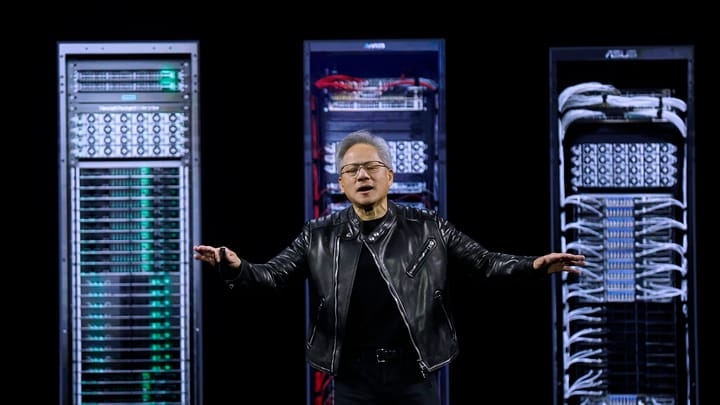
Overall data center revenue reached a record $75.2 billion, up 92%.. “The buildout of AI factories – the largest infrastructure expansion in human history – is accelerating at extraordinary speed,” Nvidia CEO Jensen Huang said in the company’s earnings release.. Nvidia’s networking business extends beyond Ethernet switches to include InfiniBand products, network interface cards, DPUs, optics, cables, and related hardware.
Together, the figures show networking has become a major growth engine as AI operators scale clusters containing tens of thousands of GPUs.. IDC said 800G switches accounted for 35.8% of data center switching revenue during the quarter, while 200G and 400G platforms represented another 34.1%..
Related:HPE Unveils ’Self-Driving’ Networking Solutions with Juniper Mist Integration. Enterprise AI Emerges the Next Battleground. The shift has intensified competition among established networking vendors.
Arista held a 20.7% share of the data center Ethernet switching market during the quarter, while Cisco accounted for 17.8%, according to IDC. White-box manufacturers also maintained a significant presence.. Butler said the competitive landscape is becoming more complex as vendors pursue both partnerships and rivalries.
Cisco works with Nvidia in some areas while promoting its own networking silicon and AI infrastructure strategy. HPE and Juniper have aligned with AMD on some initiatives while maintaining partnerships with Nvidia. Those overlapping relationships illustrate how vendors are attempting to balance participation in Nvidia’s ecosystem against the risk of becoming dependent on it..
While hyperscalers and AI cloud providers have driven much of the current spending, Butler believes the next phase of competition will unfold in the enterprise. Nvidia enters that market with momentum, but incumbents such as Cisco, Arista, and HPE/Juniper bring decades of customer relationships, operational expertise, and installed infrastructure.
Whether Nvidia can translate its AI factory success into enterprise networking may determine how durable its lead ultimately proves to be.. “That is the next battleground,” Butler said.