Trending
Thieves repeatedly steal copper and tools from Culpeper data center construction site Core Stack JV adds more data centers to €1bn Italy network Tesla appoints new head of energy programs Georgia’s Silk Cloud deploys Nvidia Blackwell Ultra GPUs Why legacy building systems deserve the same scrutiny as your network New Libyan telecom firm to launch data center in 2027 Quandela and Quanova partner for deployment of first quantum computer in Vietnam O2, Nokia complete AI RAN deployment at O2’s Giga Site in London Paddington SpaceXAI facing $6.1m fine in Mississippi for building data centers without securing correct permits Bonus Features – October 25, 2026 – 40% of orgs say identity authentication difficulties delay patient care, Epic introduces Connectors for third-party apps, plus 34 more stories HPE to send Spaceborne Computer-4 to the Moon Nokia, ICEYE pair with Ukraine’s Ministry of Defence on satellite cooperation Crown Castle bullish on carrier spectrum deployment, says it can support SpaceX’s terrestrial dreams Microsoft introduces new sovereignty tools across public and private cloud Short seller bets against Csquare, says data center firm’s shares are worthless

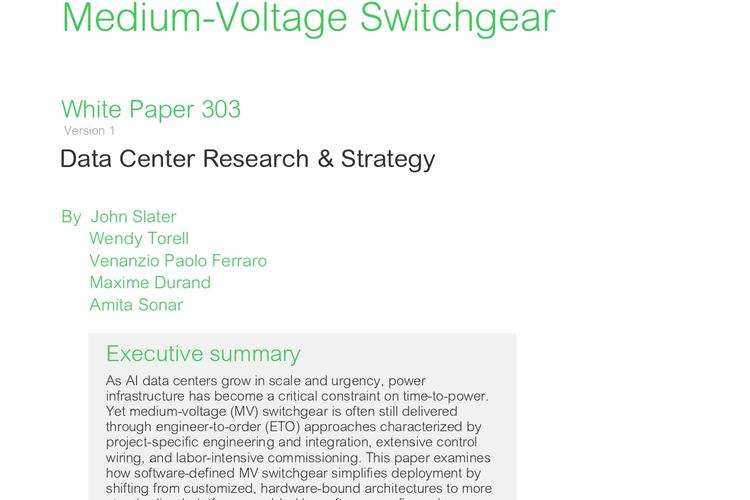
Accelerating AI data center deployment with software-defined medium-voltage switchgear

The increasing capacity of AI data centers is causing strain on power infrastructure. Traditional medium-voltage switchgear deployment can slow down the time it takes to connect power due to specific engineering, wiring, and commissioning needed for each project. Schneider Electric investigates how software-defined architectures can make the process more efficient, decreasing the deployment schedule from 31.5 weeks to just 11.5 weeks.

This whitepaper delves into how software-defined switchgear can speed up deployment and make power infrastructure simpler through:. Looking into the simplification of engineering and integration through standardized hardware and software settings. Investigating the advantages of parallel workflows and reusability of templates in enhancing manufacturing, installation, and commissioning processes.

Grasping the role of protection redundancy and networked communications in ensuring the resilience of power systems. Evaluating the advantages of a product’s lifecycle, such as increased operational adaptability, streamlined spare parts administration, and decreased reliance on raw materials


 

Join the conversation

Your email address will not be published. Required fields are marked *