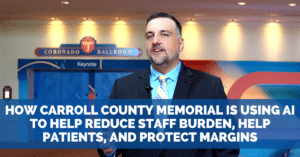
Rural hospitals face an unforgiving operational reality. Thin margins leave zero room for wasted resources, while administrative burdens drive clinical staff toward burnout. Finding technology that actually solves these problems is a matter of survival..
Waiting for perfect market maturity is not a viable strategy. Organizations must deploy practical solutions today to protect their financial health and support their staff.. Healthcare IT Today sat down with Dr.
Andy Horine, Chief Medical Information Officer at Carroll County Memorial Hospital. We explored how his critical access organization tackles these exact challenges by deploying practical automation to reduce documentation fatigue and protect financial stability.. Key Takeaways.
Eliminate after-hours documentation by capturing notes in real time. Forcing doctors to recreate a lengthy patient visit from memory at the end of the day destroys morale. Ambient technology solves this by generating notes alongside the actual encounter..
Apply automation to revenue cycle and scheduling to protect thin operating margins. Rural hospitals face constant financial pressure. Rapid billing and intelligent patient scheduling are matters of organizational survival rather than just administrative convenience..
Target a single operational bottleneck rather than waiting for perfect maturity. Organizations that delay implementation out of fear will fall behind. Leaders must identify one specific problem and test an automated solution there first.. [embedded content].
Ending the Era of Pajama Time. Expecting physicians to document patient encounters hours after the fact is a broken model now that AI scribes have officially arrived. Implementing the Oracle Health Clinical AI Agent removes this burden by capturing the conversation as it happens..
Dr. Horine noted the stark difference this ambient tool makes for his clinical team. He stated, “CAA has been truly a game changer.
Onboarding a new clinician is so much easier. Now I can say: ‘Take your phone, download the app, push this button, go be a doctor. ‘ It is that simple.”. Protecting Margins with Back-Office Automation.
Clinical tools often get the spotlight, but back-office efficiency keeps a rural hospital open. Automating routine administrative tasks accelerates cash flow and ensures patients secure the right appointments faster. Carroll County Memorial Hospital focuses on these operational upgrades through Oracle Health to defend its bottom line..
Dr. Horine is also excited about Oracle Health’s new AI powered Patient Portal which will help make it easier for patients to interact with their health data AND book appointments. “Patients are going to be able to interact [the portal] and the AI agents can say, ‘This needs an appointment.
Here’s Dr. Horine’s next available slot. ‘ It blends all those things together and it really makes that patient experience so much better and gives the patient that autonomy to understand all the aspects of their healthcare.”. With an intelligent agent that can handle the scheduling and other straightforward patient interactions, staff can focus on other tasks and margins stay healthy..
Start Small to Solve Operational Bottlenecks. Waiting for emerging technology to reach a final state of maturity is a mistake. Hospitals that wait on the sidelines risk falling permanently behind their peers.
The most effective strategy is to find an immediate pain point and apply a targeted solution.. When asked for advice, Dr. Horine gave a clear directive to his peers.
He advised, “I would tell any rural healthcare organization to understand the bottlenecks in their organization and figure out how you can actually utilize an AI agent to fix that bottleneck. Fix one, make it better, make it smoother, improve your employee satisfaction, improve your provider’s day”..
The Bottom Line. Rural healthcare leaders do not have the luxury of adopting technology for the sake of appearances. Every new application must directly defend operating margins or give time back to exhausted clinicians.
By targeting specific workflow bottlenecks, organizations can achieve immediate operational relief without taking on unnecessary risk.. Questions Healthcare IT Leaders Are Asking. How does ambient technology reduce physician burnout?.
As ChatDolphin, I can paraphrase the text for you. Ambient clinical assistants are capable of listening to patient encounters and creating clinical notes in real time, which reduces the time providers spend typing records after their shifts. This improves job satisfaction and decreases daily cognitive fatigue.
Revenue cycle automation is crucial for rural hospitals as it accelerates claim submissions, reduces coding errors, and maintains steady cash flow. To pilot new clinical technology effectively, identify a single operational bottleneck and deploy a targeted solution. This approach builds trust for future technological expansions.
You can learn more about Carroll County Memorial Hospital at their website. For the latest insights in healthcare IT, listen to Healthcare IT Today Interviews Podcast and subscribe to their newsletter and YouTube channel. To share your thoughts or inquire about advertising with them, contact them through their website or Twitter.
Oracle is a sponsor of Healthcare Scene, and you can join thousands of healthcare and HealthIT professionals who receive daily newsletters by subscribing to their mailing list. Your privacy is respected, and your contact information will never be sold or shared.