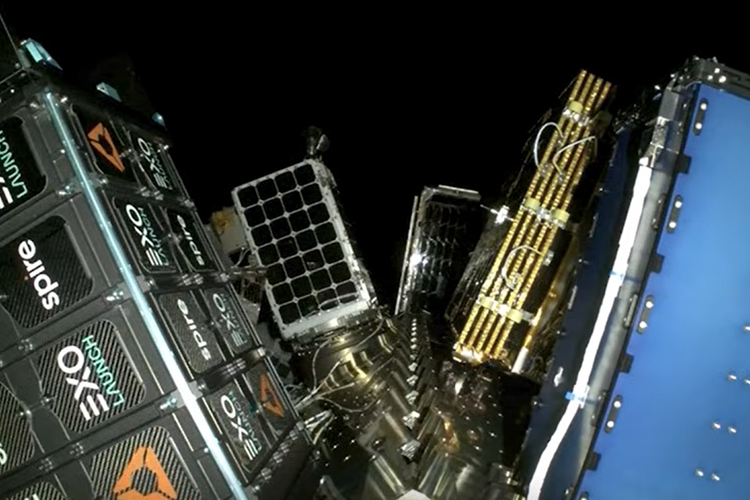
The first space data center from Google’s Project Suncatcher has successfully run a workload and communicated with Earth.. The prototype system looks to test Google’s TPU AI chips in space, as part of a plan to eventually operate gigawatts of compute in orbit.. SpaceX’s Transporter-18 rideshare mission – SpaceX.
The first Suncatcher system was launched on October 1, as part of the Transporter-18 rideshare SpaceX mission. The initial test craft, which Google has named MVP, features four TPUs, which will be powered by solar panels supplying them with 1kW.. After testing the satellite’s subsystems for the past three weeks, Google asked the Gemma 4 AI model pre-loaded onto the satellite to write a haiku about being in space..
The system downlinked the following poem via Svalbard, Norway:. Blue marble below. Data streams in silent grace.
Starlight feeds my core. ✨. The company said that it tested other space-themed limericks and telemetry prompts reporting the technical status of the payload systems.. Next, Google will continue with a series of tests to evaluate how TPUs perform under thermal stress and radiation exposure in orbit..
In 2027, it plans to test twin interconnected satellites, ahead of an eventual goal to connect up to 81 satellites as a compute cluster.. However, despite Google’s progress in orbital compute, its global head of energy and power, Amanda Peterson Corio, admitted it is not currently an economically feasible strategy..
Space data centers are “incredibly, incredibly expensive, up to 100 times more expensive than building on Earth,” she said at The Information’s Women in Tech, Media and Finance Summit 2026.. “Let’s explore all the terrestrial options before we go extraterrestrial.”.
When Suncatcher was announced last November, the company said that launch costs would have to drop substantially for it to work.. Given an estimated US data center power cost of ∼$570–3,000/kW/y, Google said that “if launch costs to LEO reach $200/kg, then the cost of launch amortized over spacecraft lifetime could be roughly comparable to data center energy costs, on a per kW basis.”.
This launch cost could be hit in 2035, Google theorized, should SpaceX’s Starship launch soon – and then launch 180 times per year. However, by 2035, the power cost of terrestrial data centers will also have changed.. 26 May 2026.
17 Aug 2026. 02 Nov 2026