Trending
Nevada ISP owner pleads guilty to embezzling more than $7.8m from Internet buildout project Envision claims to be running the world’s first 800VDC data center in Ulanqab, China Samsung SDS breaks ground on Gumi AI Data Center in South Korea Connected Infra Group appoints M&A specialist as tower company targets expansion plans Sponsored: Why flow measurement is emerging as a critical design consideration in liquid cooled data centers AWS appoints British Embassy advisor as manager of energy policy TerraVolt acquires site in Idaho to develop 240MW gas powered behind-the-meter data center campus From capacity, to the cost of intelligence NTT Data opens JKT2A data center in Indonesia Fireworks contracts 5MW of Nvidia Blackwell Ultra capacity at Era4 data center in UK Rostelecom in talks with Norilsk Nickel for underground data centers amid drone attacks Putin gives Russian companies permission to use foreign data centers after Ukraine drone strikes Microsoft buys 616 acres for $95.5m in Dallas County, Iowa No More Rip-and-Replace: Oracle Previews an Intent-Driven EHR Strategy Canada joins EuroHPC JU initiative

Water usage at AI scale

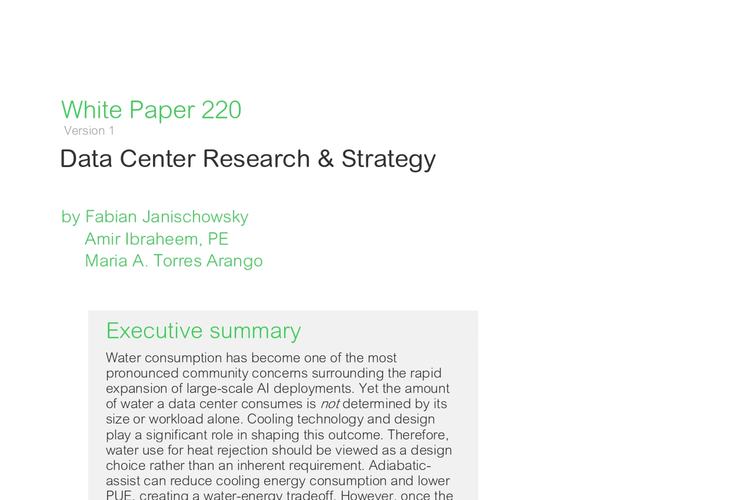
Data center water consumption is becoming an increasingly important consideration as operators plan for the next generation of AI infrastructure.. However, water use is not an inevitable consequence of larger deployments. Cooling architecture, operating temperatures and heat rejection strategies all play a significant role in determining how efficiently facilities use water and energy..

In this technical whitepaper, Schneider Electric compares four 100 MW data center cooling designs across different climates, examining how liquid cooling and optimized operating temperatures can reduce water consumption while improving energy efficiency.. Read it now to learn how to:.

Evaluate the impact of air and liquid cooling architectures on water consumption, energy efficiency and overall data center performance. Understand how increasing technology cooling system (TCS) supply temperatures can extend free-cooling opportunities and significantly reduce water usage.

Balance water and energy efficiency, cooling capacity and capital expenditure through optimized heat rejection strategies and equipment selection


 

Join the conversation

Your email address will not be published. Required fields are marked *