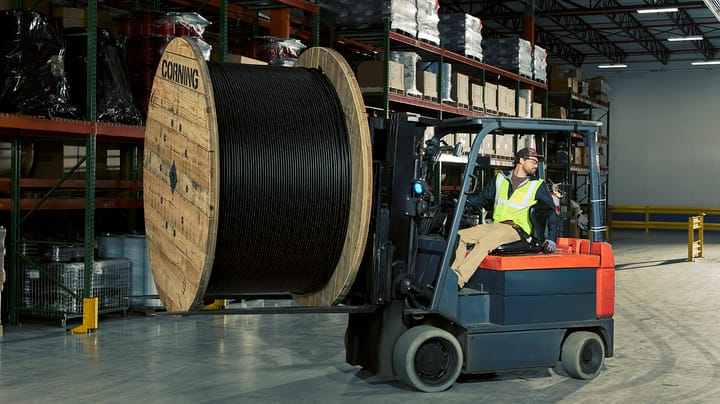
How Corning Became One of the Biggest Winners in AI. 7 Min Read. A Corning employee moves fiber cable through through its manufacturing facility in North Carolina.Photo courtesy of Corning.
Corning spent generations making glass – its humble roots planted in a small western New York town more than 175 years ago. Today, the company finds itself at the center of a multibillion-dollar scramble to secure the sprawling optical infrastructure feeding the AI boom.. Mega-Deals Signal Fiber as Strategic Capacity.
The scale of recent deals illustrates Corning’s growing role in the AI economy.. Meta agreed to purchase up to $6 billion in optical fiber, cable, and connectivity products through 2030.. Amazon followed with a multiyear, multibillion-dollar supply agreement to support its expanding US data center footprint..
Nvidia partnered with Corning to expand domestic optical manufacturing capacity, including plans for three new manufacturing plants and more than 3,000 jobs.. Together, these agreements signal that the world’s largest AI builders view optical infrastructure as strategic capacity worth securing years in advance..
Related:Nvidia Earnings Show AI Spending Moving Beyond GPUs. The demand is already showing up in Corning’s financials. The company’s Optical Communications segment grew 36% year over year in the first quarter of 2026, and Corning now expects to build a $10 billion photonics business by 2030 as AI clusters continue to expand..
“[Customers] can’t be left with GPUs or whatever accelerators they choose and deploy sitting idle because they don’t actually have optical connectivity,” said Sean Kelly, vice president and general manager of data centers at Corning Optical Communications, in an interview with Data Center Knowledge.. The agreements point to a broader industry reality: building AI infrastructure requires more than GPUs, power, and cooling.
It requires the high-density optical networks that connect increasingly large clusters of accelerators – creating opportunities for companies that didn’t feature prominently in prior waves of tech investment.. “These large-scale deals prove the AI race has shifted from a top focus on buying chips to rebuilding the physical network,” said Ron Westfall, vice president and practice lead for networking and infrastructure at HyperFRAME Research..
From Glassmaker to AI Supplier. Corning’s roots stretch back to 1851, long before cloud computing, hyperscale data centers, or artificial intelligence. Decades of expertise in specialty materials and manufacturing positioned the company to become one of the world’s leading suppliers of optical communications infrastructure..
For years, optical fiber remained largely invisible to most technology discussions. It carried internet traffic, linked data centers, and formed the backbone of communications networks, but rarely attracted the attention directed toward servers, semiconductors, or software.. Related:Will Co-Packaged Optics Transform Data Centers?.
That all changed with AI. Training and operating large language models requires thousands of accelerators working together across increasingly large clusters. As those systems grow, so does the need to move vast amounts of data across racks, rows, buildings, and campuses..
Kelly said AI networks require dramatically more connectivity than traditional environments. “If you’re looking at a switch rack, you’re looking at server rack density of fiber relative in these new AI networks is about 10x what you might have seen in enterprise, traditional cloud, kind of front-end networks,” he said.
“Now that’s only increased with each generation of chips.”. The sheer scale of AI deployments is creating what Kelly described as a compounding effect: larger GPU clusters, growing campus footprints, increasing bandwidth requirements, and additional switching layers – all driving demand for more fiber and connectivity..
Why Hyperscalers Are Locking in FIber Year Ahead. The Corning agreements stand out not only for their size but for what they suggest about customer behavior. According to Kelly, hyperscalers increasingly view optical infrastructure as a critical dependency rather than a commodity purchase.
Historically, customers purchased networking infrastructure through conventional procurement cycles. Today, hyperscalers are seeking both innovation partners and long-term manufacturing commitments.. Related:NC Tech Talk: AI Infrastructure Concerns Shift From GPU Growth to Efficiency.
“There are two fundamental challenges our customers are trying to solve,” Kelly said. “One, there’s an innovation challenge. There’s a need for a new set of products, a new set of product capabilities.
The second challenge really is around manufacturing scale.”. Corning’s role extends beyond supplying products. The company is working with customers to develop denser connectivity systems while simultaneously expanding manufacturing capacity to support future demand..
Capacity Planning Extends to 5- to 10-Year Horizons. Perhaps the biggest shift is how far ahead customers are planning. Kelly said conversations that once focused primarily on products and near-term demand now revolve around manufacturing roadmaps, capacity expansion, and long-range forecasting.
“The biggest change in the dialogue today is the time horizon,” he said.. Cameron Daniel, chief technology officer at Megaport, said the concept of planning ahead is evolving alongside AI infrastructure demand. “The definition of ‘planning ahead’ has changed to be more in line with ’adapt faster,’” Daniel said.
“Businesses should also have a quick-response plan in hand so they know where to go for capacity when there’s a sudden demand.”. As hyperscalers better understand the complexity of adding fiber, cable, and connector manufacturing capacity, they are engaging suppliers earlier and sharing longer-term projections.
“What all these hyperscalers are doing is such a phenomenal scale relative to the scale deployed in our industry historically,” Kelly said.. Daniel said the changes are especially visible at the service-provider layer. “Previously their customers … used to buy in circuits and wavelengths.
Now they’re buying in fiber pairs, and not just one,” he said. “We’re seeing instances of hundreds of terabits of capacity between data centers for moving data around to train, refine, and ship these models.”. Those dynamics are producing a different kind of suppliers-customers relationship.
“The best path for us to solve your problem is for us to work together to come up with a supply solution for you,” Kelly said.. Corning’s financial outlook suggests those planning horizons extend well beyond current AI deployments. In May, the company upgraded and extended its Springboard growth plan, outlining a path to a $40 billion annualized sales run rate by 2030 while targeting a $10 billion photonics business.
Executives tied much of that growth to expanding AI clusters, optical scale-up architectures, and long-term customer agreements.. Chief Financial Officer Ed Schlesinger said Corning plans to “appropriately share the risk of our investments through our long-term customer agreements,” a model that reflects the strategic role optical infrastructure plays in the AI buildout.
Rather than buying products as needed, customers are de-risking manufacturing investments and capacity expansions years ahead of deployment.. A New Class of AI Infrastructure Winners. Corning’s emergence as an AI infrastructure winner mirrors a broader industry shift.
While Nvidia remains the most visible beneficiary of AI spending, billions of dollars are flowing into the physical systems required to support accelerated computing. Companies supplying power equipment, cooling systems, electrical infrastructure, networking hardware, and connectivity products are all benefiting..
Westfall sees Corning as part of a larger group of industrial companies capturing value from AI’s physical requirements. “Power management players Eaton and Vertiv have emerged as major AI beneficiaries by accumulating backlogs for the custom transformers, switchgear, and liquid cooling technology required to support dense computing clusters,” he said..
The common thread is straightforward: AI requires physical infrastructure at a scale few expected even a few years ago.. The Manufacturing Race Behind AI. Kelly argues that the industry still underestimates the manufacturing implications of the AI boom.
“I think most of the dialogue has been around that this is a pretty incredible tech play,” he said. “But I think this is an incredible manufacturing opportunity as well.”. Corning recently announced plans to expand optical manufacturing capacity in North Carolina, part of a broader effort to support growing demand from AI infrastructure builders.
For Kelly, the challenge extends beyond innovation. It also requires building the factories, supply chains, and production capacity needed to support increasingly ambitious deployment plans. “I think what they’re learning is that there is a really big manufacturing opportunity here at play,” Kelly said.
“A really big opportunity to expand the manufacturing base of domestic supply.”. Daniel said the traffic patterns are evolving. While optical networking remains fundamental to AI training clusters, much of the newest demand is being driven by inference workloads, making distributed GPU and CPU deployments at the edge an increasingly important part of infrastructure planning..
The AI boom is often described in terms of models, chips, and software. It is also becoming a story about factories, supply chains, and industrial capacity. For Corning, that reality has transformed optical infrastructure from a background component into strategic capacity – something hyperscalers are increasingly willing to reserve years before they need it..
About the Author