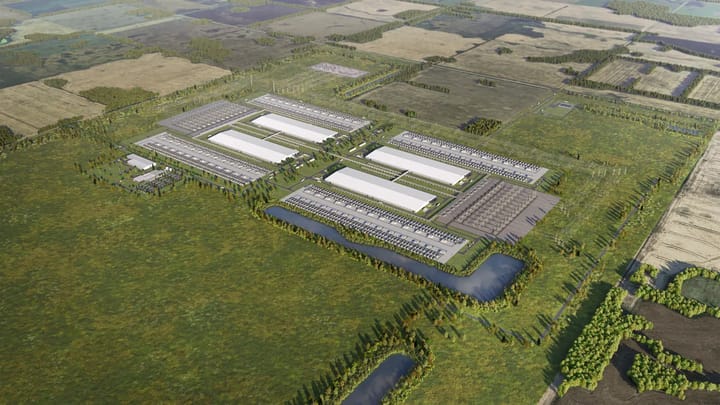
In Sturgeon County, Alberta, Meta is planning to build its inaugural Canadian data center, representing an investment of over US$9 billion (approximately C$13 billion). The 1 GW AI campus is anticipated to employ about 3,000 construction workers at its peak and more than 300 permanent employees once it becomes operational.
In addition, the firm intends to allocate roughly $42.3 million towards enhancing regional road and water systems. This revelation stands as one of the most substantial AI infrastructure investments unveiled in 2021. However, the most significant aspect might be Meta’s explanation of their process before constructing it.
They collaborated with Greenlight Limited Partnership, AltaLink, Capital Power, and the Alberta Electric System Operator to anticipate and fulfill our energy requirements years before the data center becomes operational. This provides insight into how hyperscalers are planning for the future of AI infrastructure.
Instead of declaring campuses and subsequently seeking control, operators are more and more often securing power generation, transmission capacity, and regulatory compliance before revealing their projects to the public. With campuses growing from hundreds of megawatts to gigawatts, securing electricity for several years in advance is becoming crucial in choosing locations and completing projects.
This is relevant to the news that Qualcomm has secured a deal with Meta for their CPUs and has introduced an AI Data Center Platform. As hyperscalers strive to broaden AI infrastructure to accommodate progressively compute-demanding models, Meta’s declaration arrives. In the ongoing competition, major tech companies including Meta, Microsoft, Amazon, Google, and Oracle have revealed significant investments in AI infrastructure.
This race is shifting from focusing on acquiring sites to controlling the power-path, according to Neil Osnato, the founder of Persistence Analytics Group. For a 1 GW AI campus, the mere presence of land and GPUs is insufficient.