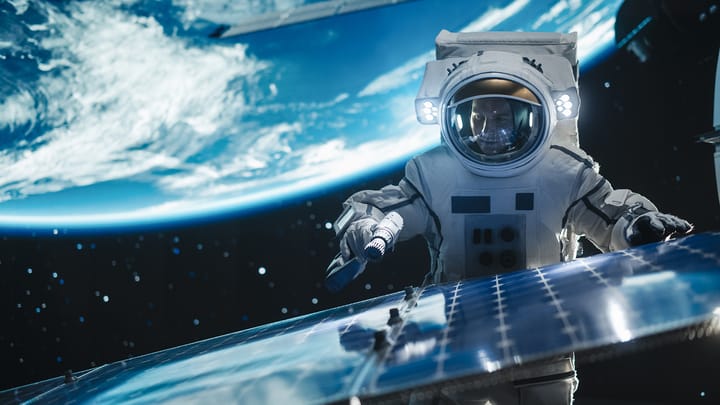
It’s the year 2035.. Orbital data center technician Ian Teachey is halfway through his breakfast of freeze-dried scrambled eggs when the trouble ticket arrives:. ATTITUDE CONTROL ANOMALY DETECTED.
Teachey sighs.. “Tuesdays,” he mutters.. A failed server would be easy..
This is worse.. The attitude control system keeps a spacecraft pointed where it needs to be. Lose it, and solar arrays drift off the sun.
Radiators struggle to reject heat. Power generation falls. Temperatures rise.
A routine maintenance job becomes a costly headache.. The scene is fictional – for now.. But the idea behind it is not..
Interest in orbital computing is growing as terrestrial infrastructure runs into familiar obstacles. Wood Mackenzie forecasts that global data center power demand will rise from about 460 TWh in 2026 to 3,700 TWh by 2040. Meeting that demand will require substantial new capacity, as developers contend with grid interconnection delays, water constraints, and rising construction costs..
Related:Data Centers in Space: Hype, Reality, and the Long Timeline Ahead. Those pressures are driving serious exploration of alternatives such as orbital data centers, even though the cost of a hypothetical 1 GW orbital data center would be more than three times that of an equivalent terrestrial facility, according to a Wood Mackenzie estimate..
Constellations vs. Facilities: Who Survives Operations?. Orbital data centers are a real possibility with plenty of financial backing.
The question is which architecture will survive operations.. The term “orbital data center” encompasses several distinct approaches:. Axiom Space is developing orbital data center nodes and computing infrastructure intended to support cloud computing, AI, cybersecurity, and data processing in space, with systems eventually integrated into its planned commercial space station..
Starcloud is pursuing a constellation model, having already flown an Nvidia H100 GPU in orbit and planning a network of tens of thousands of computing satellites designed to function as a distributed orbital data center.. SpaceX has floated an even larger vision, applying the Starlink manufacturing, launch, and constellation-management model to orbital computing infrastructure deployed at a massive scale using Starship..
These differences will determine almost everything that follows: maintenance philosophy, logistics, economics, and operational risk.. Retired astronaut Chris Hadfield sees an even sharper divide between orbital data center nodes and satellite constellations, and he’s placing his bets on Elon Musk and his SpaceX endeavor.
In Hadfield’s view, the most viable systems will resemble satellite constellations rather than orbital facilities, borrowing heavily from the manufacturing, launch, and operational model developed for Starlink.. Related:Power Emerges as AI’s Defining Limit. Much of the discussion centers on launch vehicles, power generation, communications, cooling, and economics.
Less attention goes to a simpler question: What happens after launch?. A data center operator sees servers and networking connections.. A flight director sees a spacecraft..
The Operational Imperative in Orbit. Former NASA flight director Paul Hill did not hesitate when asked what trouble ticket he would least want to receive from a future orbital data center: “Attitude control failure. Thermal control system failure.
Power generation failure. In that order.”. Before an orbital data center can process a single inference request, it must first maintain orientation, generate power, reject heat, survive radiation, avoid debris, and continue functioning despite failures.
Hill learned that lesson during years of International Space Station (ISS) operations. Reaction-wheel lubrication issues surfaced after reaching orbit, he said in an interview. Electronic switches behaved unexpectedly in the space environment.
Other problems emerged only after the hardware had spent months operating in orbit. The details differed, but the pattern did not.. Related:Data Center Space Race: Can Orbital’s Satellites Overcome Doubts?.
“There’s always some devil in the detail that you hadn’t thought of,” Hill said. “Once you get it into orbit, it’s going to behave in a way that you missed.”. The Failure Modes You Don’t See Coming.
Orbital Operations Log 412, 06/26/2035. 03:17 UTC. Cooling Loop B operating below expected efficiency..
Rack temperatures rising.. Workload migration initiated.. Spare pump inventory: 1.. – I.
Teachey. Hill doesn’t focus on whether failures will occur – they will. The deeper challenge is discovering which failures nobody anticipated..
On the ISS, even seemingly routine conditions created unexpected problems. Early station computers used physical hard drives, and vibrations from docking events produced behavior that took time to diagnose.. Most failures look obvious once explained.
In a tightly coupled system, one problem often triggers another. For example, lose attitude control, and power and thermal margins shrink. Lose thermal control, and compute performance throttles.
Lose power, and availability collapses. That sequence maps directly to data center capacity, reliability, and SLA risk.. When the Hardware Keeps Running and the Answer Changes.
A particularly insidious risk for orbital AI is radiation-induced soft errors. In a 2024 study examining the effects of radiation on AI workloads in space, Mohammad Reza Tanjil and colleagues at the University of Louisiana at Lafayette estimated that a typical application occupying roughly 40 MB of memory could experience more than 150 bit errors per day in orbit.
Those faults do not necessarily crash a system or trigger an alarm; they can simply alter the computation. In testing, a single bit error could cause an object-detection model to miss targets or misidentify them. The hardware continued operating.
Only the answer changed.. For operators, that may be the most difficult failure mode of all. Systems stay online.
Service levels appear normal. The result is wrong.. “You engineer solutions to 150 problems,” Hill said.
“Then a year later, something appears, and you realize you missed it.”. Hill is not alone in focusing on operations. In a 2026 orbital data center feasibility analysis, J.
M. Horack argued that replenishment latency, replacement cadence, reserve capacity and fault management are central economic variables for orbital computing systems. Rather than assuming crews servicing equipment in orbit, the model relies on telemetry-based health management, spare nodes, software updates and replacement cycles to maintain availability..
Horack is describing on paper the operational reality NASA eventually experienced on the ISS.. A SpaceX Falcon 9 rocket carrying the company’s Dragon spacecraft is launched on NASA’s SpaceX Crew-11 mission to the International Space Station with NASA astronauts Zena Cardman, Mike Fincke, JAXA (Japan Aerospace Exploration Agency) astronaut Kimiya Yui, and Roscosmos cosmonaut Oleg Platonov onboard at Kennedy Space Center Launch Complex 39A on August 1, 2025, in Cape Canaveral, Florida. (Photo by Miguel J.
Rodriguez Carrillo/Getty Images). Logistics: From Spare Parts to Propellant. Over time, the ISS evolved into something that looked less like a spacecraft and more like infrastructure.
NASA ultimately managed more than 6,000 Orbital Replacement Units (ORUs) supported by spare inventories numbering in the hundreds of thousands. Components failed, inventories expanded, repairs consumed crew time, and logistics became mission-critical. One NASA logistics paper summarized the reality bluntly: “Hardware is flying and hardware is failing.”.
Modern terrestrial data centers rarely operate under these conditions. If a component fails, a technician can walk to the rack, spares sit nearby, and additional equipment arrives by truck. In space, a truck delivery becomes a rocket launch..
Researchers studying on-orbit servicing are reaching conclusions that would sound familiar to any supply chain manager. A Georgia Tech-led framework modeled a future servicing ecosystem built around customer spacecraft, servicing vehicles, depots, repair operations, spare inventories, and replenishment launches from Earth.
In the 2026 paperOn-Orbit Servicing-Integrated Maintenance Strategy for Satellite Constellation, researchers at the Korea Advanced Institute of Science and Technology modeled constellation maintenance as a complex supply chain incorporating ground spares, orbital spares, servicing vehicles, and depots stocked with fuel and replacement units. Failed satellites enter a recovery queue while operators decide whether to restore a spacecraft through on-orbit servicing or replace it with a newly launched satellite..
The STARFAB project is developing an Orbital Automated Warehouse Unit for storage, assembly, servicing, and maintenance in space, along with robotic inspection systems that can handle replacement parts and perform basic repairs. The future warehouse already has a maintenance crew – only, they are robots..
Hill cautioned that robotic servicing remains far more difficult than many orbital infrastructure concepts suggest. The challenge is not simply building a capable robot; it’s designing a spacecraft that can be repaired by one.. He offered a simple example.
Replacing a computer card might require opening an access panel, removing hardware, installing a replacement, and reconnecting interfaces. A human can perform many of those actions almost instinctively. A robot often cannot.
Access panels, connectors, attachment points, replacement procedures, and service interfaces might all need to be engineered specifically for robotic maintenance. Without those features, significant repairs can become extraordinarily difficult after launch.. “If you want a serviceable spacecraft, you have to design that up front,” Hill said..
The same principle applies to logistics. One of the most underestimated challenges, Hill said, may be propellant resupply. Long-lived platforms require fuel for attitude control, orbital maintenance, station keeping, and emergency operations.
Every kilogram of propellant must be launched, transferred, stored, and replenished.. Historically, transportation has been among the highest costs in space operations. Launch costs continue to fall, but propellant still has to come from somewhere..
The future may require warehouses.. It may also require orbital gas stations.. Replace or Repair?
The Economics Decide. Orbital Operations Log 731, 06/26/2035. 18:17 UTC.
Attitude control nominal.. Power systems nominal.. Thermal systems nominal..
Replacement pump received from Depot Three.. Cooling Loop B restored to service.. – I. Teachey.
Hadfield is skeptical that orbital computing will evolve around maintenance-heavy platforms in the near term.. “If you’re relying on maintenance, the loop wouldn’t even ever come close to closing,” he said.. In his view, launch costs must fall far enough that failed hardware can simply be replaced on a cadence, with old units deorbited at end of life.
The model resembles a satellite constellation more than a terrestrial facility.. Wood Mackenzie Research Director Robert Liew told Data Center Knowledge that orbital computing systems begin to resemble fleets rather than facilities once launch costs fall below roughly $100 per kilogram.
Below that threshold, operators can build and replace hardware at scale instead of servicing individual systems.. The future may not resemble ISS or Starlink; it may end up somewhere in between. Researchers envision ecosystems with depots, servicing vehicles, maintenance robots, replenishment launches, and orbital warehouses.
At the same time, Hill sees merit in the disposable orbital data center option.. “You build them in a way that you just keep building cheap ones and throwing them up there and throwing the old ones away,” Hill said.. In that model, maintenance becomes a manufacturing problem rather than a repair problem.
The economics depend on whether replacement launches become cheaper than maintaining aging hardware in orbit.. A recent analysis of six years of Starlink deployment data found a constellation in near-constant motion, with satellites routinely repositioning, changing altitude, avoiding collisions, and cycling out of service after only a few years.
The network itself remains in continuous evolution. The largest orbital infrastructure system ever built behaves less like a building and more like a fleet.. The counterargument remains credible.
Proponents of serviceable platforms argue that as on-orbit servicing and refueling mature, lifecycle costs for repairable infrastructure may undercut the costs of rapid replacement, especially for high-mass, high-value modules. The industry may ultimately adopt a hybrid: replace the small stuff, repair the big stuff..
Timelines and Expectations. Hill does not view orbital data centers as a distant possibility. If an existing spacecraft platform proves viable, he believes operational systems could emerge within three to five years.
Purpose-built platforms may take longer, perhaps seven to 10 years.. The timeline may matter less than the process. Operators will not discover every failure mode on the ground.
They will put a smaller number up first, learn in orbit, and iterate, Hill said – just as NASA did during the early years of ISS operations.. Engineers solve 150 problems. Reality introduces the 151st..
Sometimes a bearing fails. Sometimes a hard drive fails. Sometimes the hardware keeps running, and the answer changes.
And somebody still has to own the failure.. If Hadfield is right, maybe Teachey’s Tuesday never arrives.