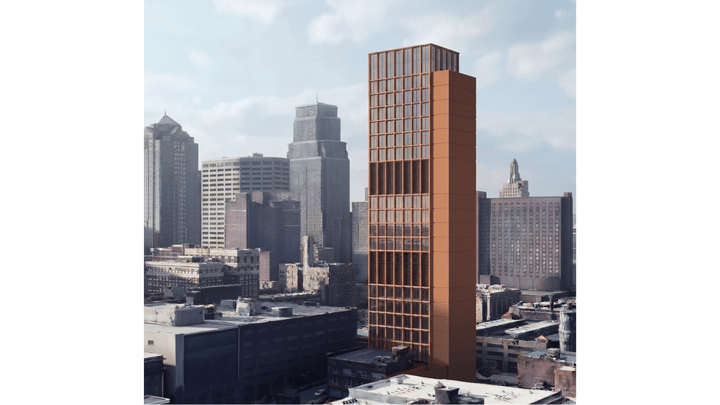
A proposed 20-story data center tower in downtown Kansas City, Missouri, offers an alternative to sprawling suburban campuses: stack computing, power, and cooling on a small urban parcel and leverage dense, carrier-rich connectivity. But stacking infrastructure vertically introduces additional costs and operational complexity, and the case for a downtown address depends on whether proximity and network diversity justify the construction premium..
Designed by storied Chicago architecture firm Skidmore, Owings & Merrill (SOM) for developer Revitalization Unlimited, the facility would occupy approximately 0.23 acres. The project remains subject to approval; a related city development plan ordinance is listed as on hold until October 13..
Why Proximity Matters for Urban Sites. Steve Austin, founder and CEO of Revitalization Unlimited, argues that inference workloads and dense network interconnections support a central location.. Related:Data Center Architects Reimagine Facilities as Urban Assets.
“Inference is the model actually answering a user, and it has to happen near that user because latency matters,” he told Data Center Knowledge.. Austin pointed to nearby carrier infrastructure, planned diverse fiber entrances, and a carrier-neutral design as advantages for customers that value fast connections to users and other networks.
Whether that proximity is worth a premium depends on the workload.. Luis Fernandes, IDC senior research manager for cloud and data centers within enterprise infrastructure, cited high-speed financial transactions as an example where physical proximity can matter.. “It is not uncommon for stock traders to seek addresses closest to the actual stock exchange servers where transactions are processed in order to gain a few fractions of a second in any given transaction,” Fernandes told Data Center Knowledge..
He added that the economics depend on the premium for building vertically.. Michael Martin, managing director of data center operations at JLL, said customers generally approach location decisions based on their business requirements rather than a preference for downtown.. “The reality is that clients don’t come to us asking for a downtown data center,” he said.
“They’re usually trying to solve a business problem.”. Martin sees opportunities in financial services, telecommunications, content delivery, and inference at urban sites, while large AI training clusters typically favor abundant land and power.. The Cost of Building Upward.
Austin estimated total development costs at $183 million, or roughly $1,300 per square foot, acknowledging that it exceeds the per-square-foot cost of a suburban facility. Much of the expenditure would go toward mechanical, electrical, plumbing, and fire protection systems – about $107 million of the estimated $167 million in hard construction costs..
Related:Urban Data Centers: Who Needs Them and Where to Find Them. The proposed building would support 24 MW of IT load. Only two of its 20 floors would house computing equipment, according to Austin, with approximately 109,000 of its 141,000 gross square feet devoted to mechanical space.
Those proportions illustrate the trade-off: land saved at ground level must be recaptured by stacking substantial supporting infrastructure above it.. Fernandes said equipment placement in vertical builds creates practical challenges. Most vendors design power and cooling equipment for horizontal placement, with very little consideration for vertical deployment, he said..
Weight, freight elevator dimensions, and crane access all matter. Replacing equipment may require coordination with surrounding streets, while pumping cooling water introduces demands different from those in a conventional commercial tower.. Smaller Physical, Not Necessarily Smaller Footprint.
Fernandes cautioned against assuming reduced land consumption equates to a smaller overall environmental footprint.. Related:Do We Really Need Mega Next-Gen Data Center Campuses?. “There is no data to suggest that a vertical build will impact the overall environmental footprint,” he said..
Austin said the Kansas City design targets a power usage effectiveness (PUE) of 1.25 and would use 30 MW of on-site Bloom fuel cells as the primary electricity source. These are proposed performance and operating characteristics.. Self-generation also requires examining the fuel supply.
Austin identified natural gas as one of the facility’s expected operating expenses, meaning that independence from the electricity grid should not be confused with the absence of environmental impacts.. Cooling claims likewise need precision. Fernandes questioned the description of the project as a closed loop while also noting that it includes evaporative cooling, which consumes water.
Cities and prospective customers will need operating figures to evaluate those trade-offs.. Looking beyond the Kansas City proposal, Martin sees potential in converting suitable existing buildings for smaller or edge workloads.. “Reusing existing structures, utility connections, and supporting infrastructure can reduce waste while also improving project economics and speed to market,” he said.
That case depends on a building’s suitability for added power, cooling, and operational demands.. What Communities Gain – and Expect – in Return. Austin emphasized tax revenue and local spending while acknowledging limited permanent staffing..
“On-site operations staff is a couple of dozen,” he said. “The rest are technicians, contractors, and service firms the facility pays continuously, plus the jobs supported by their spending.”. He said the developer is seeking no tax abatement and is prepared to accept binding conditions covering active ground-floor space, noise, generator operating hours, construction apprenticeships, and public reporting..
Fernandes argued community benefits should extend beyond tax receipts, suggesting partnerships with trade schools and facilities such as libraries or daycare services.. “[Make] the data center a part of the community instead of something forced upon a community,” Fernandes noted..
Designing for Flexibility and Reuse. Long-term usefulness is another consideration. Fernandes noted older facilities can be retrofitted or reassigned to less demanding workloads, although a tower’s physical constraints would need to be assessed..
Martin said adaptability should guide design decisions as computing requirements change.. “The facilities that remain valuable over the long term are the ones that can adapt,” he said. “That means flexibility in power distribution, cooling architecture, structural capacity, and overall building design.”.
The broader test is whether a specific location provides enough operational and public value to justify the additional complexity. Austin maintains that his proposal meets that test.. “We are not arguing that every data center belongs downtown,” he said.
“We are arguing this one does, and we are paying a construction premium to prove it.”