
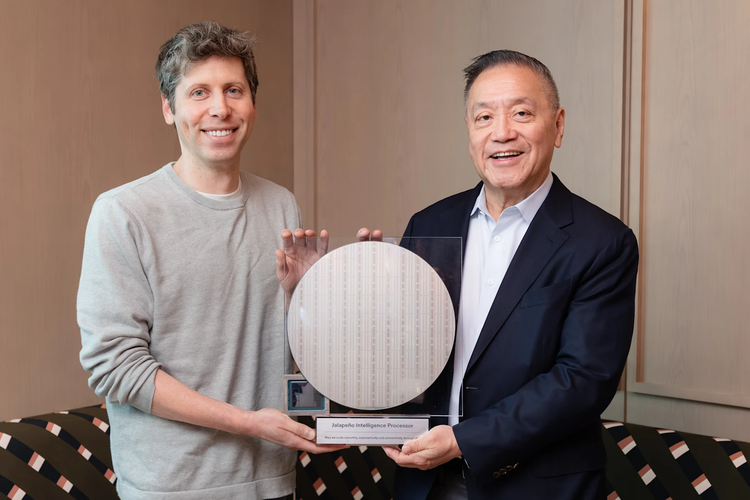
OpenAI and Broadcom have debuted their first co-designed AI chip of a planned multi-generation compute platform.. ‘Jalapeño’ is set to be OpenAI’s first Intelligence Processor, designed for large language model inference.. OpenAI CEO Sam Altman (left) and Broadcom President and CEO Hock Tan (right) holding the Jalapeño Intelligence Processor (wafer) – OpenAI/Broadcom.
OpenAI said that it designed the chip from scratch “around its deep understanding of LLM fundamentals, informed by its roadmap of models, kernels, serving systems, and product needs,” with partners Broadcom and electronics manufacturing firm Celestica helping to bring the silicon to fruition.. Engineering samples of the Jalapeño chip are running ML workloads in the lab at production target frequency and power, including GPT‑5.3‑Codex‑Spark..
OpenAI said that it was still measuring final performance, but claimed that early testing shows that Jalapeño will deliver performance per watt “substantially better than current state-of-the-art.”. The company has promised a detailed technical report on performance in the coming months.
OpenAI said that the architecture reduces data movement and balances compute, memory, and networking resources with an expected utilization much closer to theoretical peak performance.. Broadcom’s Tomahawk networking silicon is used as part of large-scale production.. “The world is moving to a compute-powered economy,” said Greg Brockman, president and co-founder of OpenAI..
“Jalapeño is part of our long-term full-stack infrastructure strategy to make compute more abundant, resulting in AI which is faster, more reliable, more affordable for people and businesses, and can be used to solve more important problems. By designing more of the stack ourselves, we can serve more intelligence with greater efficiency and keep pushing advanced AI toward broader access.”.
Richard Ho, head of OpenAI’s hardware program, added: “Jalapeño was designed from the ground up for LLM inference using detailed insights from our close collaboration with OpenAI researchers. We optimized the architecture around the kernels, memory movement, networking, and serving patterns that matter most for frontier AI models.
Based on early testing, Jalapeño will efficiently execute our most important workloads close to the hardware’s theoretical limits.”. Jalapeño was co-developed from initial design to manufacturing tape-out in just nine months, the companies said, which they claimed was likely the fastest ASIC development cycle ever achieved in high-performance advanced semiconductors..
Part of that speed was due to the use of OpenAI models to accelerate parts of the design and optimization process, the generative AI company said.. Initial deployment is expected by the end of 2026.. 16 Mar 2026