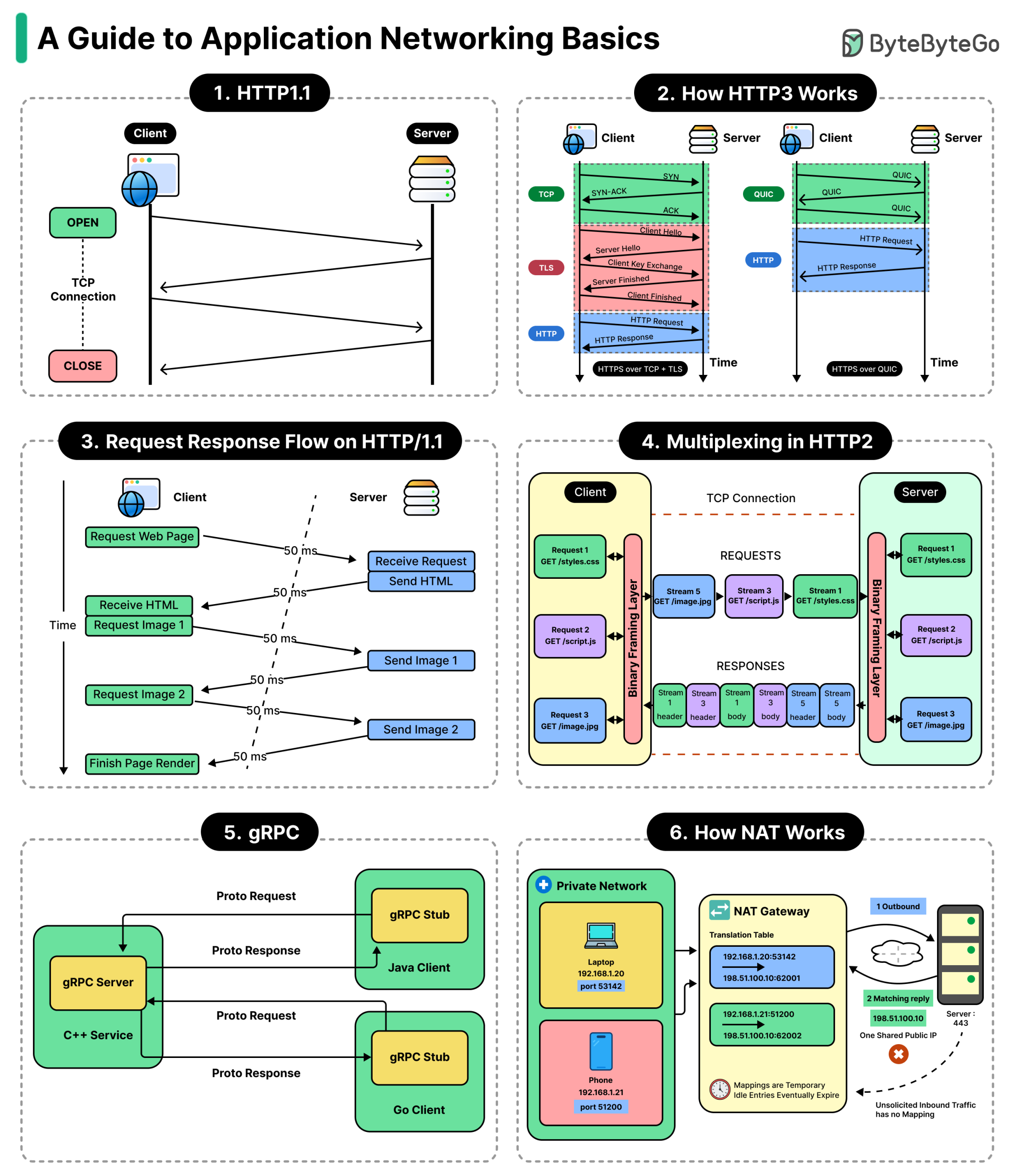
Imagine a simple scenario where an e-commerce web application calls an API endpoint that returns information about a customer order.. At the application level, this looks like a pretty simple operation. But a lot is happening under the hood.
First, the client queries the DNS for the IP address linked to the API endpoint. DNS might return the address of a load balancer rather than the address of a specific application server. The operating system then determines how packets should be sent to that IP address.
It might choose to send them through the local network, an internet service provider (ISP), or several other routers. The ultimate goal is for the data packets to reach the destination network.. The most common protocol used for this is HTTP.
However, before HTTP can send the request, the client usually needs to establish some form of connection with the destination server.. With traditional HTTPS, this means setting up a TCP connection. In this type of connection, the client and server perform a handshake by exchanging some initial packets so that both sides know a connection has been established.
The client and server then perform a TLS handshake. Only after this can the HTTP request be sent securely. A load balancer receives it, selects a healthy application instance, and forwards the request.
The application performs its work and sends the response back through the same path.. All of this falls under the realm of networking. Due to its ubiquitous nature, networking becomes an extremely important discipline for developers to master.
In this article, we will look at the various aspects of networking in detail.