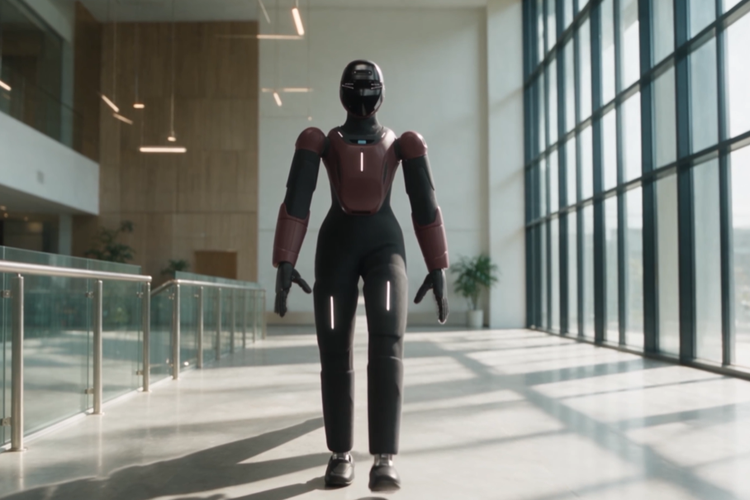
Generative Bionics, a company in the robotics industry, is constructing an AI data center in Italy. This data center will be part of a facility aimed at developing humanoid robots for use in industrial settings. The facility, which spans 5,000 square meters (or 53,303 square feet), has been named the Physical AI Data Factory.
Its purpose is to facilitate the transition of humanoid robotics from lab demonstrations to reliable industrial deployment and to strengthen European humanoid autonomy. The company intends to ensure that the data, models, and expertise driving Europe’s industrial humanoids are cultivated, trained, and verified within the continent.
Generative Bionics has also set its sights on establishing humanoid robot production facilities. Generative Bionics intends to construct a data center in an undisclosed location within the Liguria region of Italy, its home base. Although the IT capabilities of the site remain undisclosed, the organization stated that it will be powered by AMD Helios infrastructure.
They also mentioned that the site may be partially operational by Q4 2027. This will enable the company’s fleet of its initial robot, Gene. To carry out tasks consistently in actual circumstances.
The operations will produce precise physical data for training global action models and verifying the entire robotic system, including perception, control, safety behavior, and task execution, prior to customer site deployment, according to Generative Bionics. Additionally, each physical setting and robot configuration will be replicated as a digital twin, enabling tasks to be performed across numerous variations in layout, objects, materials, operating conditions, and failure modes that would be too complex to reproduce physically.
The company plans to deploy robots that have been trained and tested in simulation for validation, and will use data from physical operations to continue training in the next cycle. According to Daniele Pucci, CEO of Generative Bionics, they are creating a replicated world both physically and digitally to train large numbers of humanoid robots before they are introduced to the real world. “The way we execute the AI data factory is by deploying numerous Gene fleets.” By learning from actual industrial work, we rigorously test the acquired skills through numerous digital-twin simulations on AMD compute systems.
Once validated, these world action models are then reintroduced into the real-world environments for use in the action intelligence layer of physical AI, enhancing customer experiences.