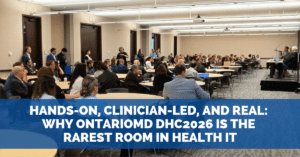
I just spent time at the OntarioMD Digital Health Conference 2026 (DHC2026), and if you think the primary care technology space is sleepy, think again. This year the exhibit hall was filled with a fantastic mixture of physician-led vendors with solutions that solve real clinical and administrative frustration.
In addition there were a lot of deep discussion about AI, privacy, efficiency, patient access, and costs.
Key Takeaways from OntarioMD DHC2026
- AI Beyond Scribes: According to a recent survey by OntarioMD, scribe adoption has hit 58%. This is remarkable given the relatively short time this technology has been available. This has pushed vendors to evolve quickly beyond AI for clinical documentation – and into full-clinic automation, intelligent triage, inbox sorting, billing reconciliation, and clinical decision support.
- Clinician-Led Problem Solving: Rather than waiting for big tech roadmaps, frontline physicians and community leaders are actively building and adopting targeted tools to fix clinic bottlenecks, intake friction, and lost revenue.
- System-Level Guardrails and Procurement: Between OntarioMD’s collaborative work on CACDI data standards with CIHI and the province’s centralized Primary Care Medical Record (PCMR) initiative, privacy, EMR migration, system integration, and provincial vetting are becoming mandatory table stakes.
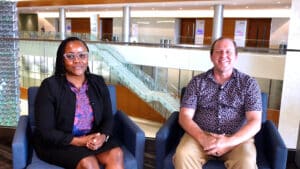
Video features: Robert Fox, Dr. Chandi Chandrasena, Chris Sulway, Ariane Siegel, and Andrew King from OntarioMD, Chrstine McKenzie from CIHI, Mark Casselman from Akinox, Raz Tram from VendorBay, Brent Carabott from Ontario Health, Dr.
Bart Kaczmarek from DoctorFlow, Tarek Kekhia from Elevation Technology Labs, Meet Shah from Phelix AI and Dr. Gursharan Soor from FHO+ TrackerPro
Beyond the Scribe: 360-Degree Clinic Workflow
A couple of years ago, ambient AI scribes were the shiny new toy. Today, the market has matured significantly. As Robert Fox, CEO at OntarioMD pointed out to me, the focus has shifted toward a “360 clinic visit philosophy”.
Instead of just generating an encounter note, AI tools are now expected to support the entire lifecycle of a visit—from pre-visit intake and report summarization to clinical decision support (AI CDS), test ordering, and referral routing.
Dr. Chandi Chandrasena, Chief Medical Officer at OntarioMD emphasized that clinicians are drawing a firm line: they don’t want AI replacing their diagnostic judgment or patient-facing time. They want it handling unwanted administrative burdens like billing rejections, scheduling, and repetitive paperwork.
On the exhibit floor, vendors were getting the same message. Rather than standalone AI scribe apps, solutions addressed administrative workflow pain points: automated fax processing that links directly into EMR charts, centralized e-referral workflows that update patients directly, and AI powered patient journey automation that makes it easy for patients to move to the next step in their care.
Physician-Built Technologies Shine at DHC2026
One of the most refreshing aspects of DHC2026 was discovering how many practical tools were built by clinicians. I ran into practicing family physicians who were frustrated by specific, nagging inefficiencies and decided to take matters into their own hands.
One physician, Dr. Gursharan Soor, walked me through FHO+ Tracker Pro, a billing optimization app he initially built himself to reduce claims rejections and steamline billing. It saved him hundreds of dollars each month and he has made it available, for free, to any practicing physician.
Another family doctor, Dr. Bart Kaczmarek, told me how he developed DoctorFlow to solve exam room bottlenecks for his 10-room clinic after traditional door flags broke down. This simple solution is targeted at a very specific administrative challenge and is representative of the physician-led innovation that is happening in Ontario.
Privacy and EMR Migration
Behind the excitement on the floor, governance and privacy were serious topics of conversation. Clinicians want efficiency, but not at the expense of PHIPA compliance or legal exposure. Ariane Siegel, General Counsel and Chief Privacy Officer at OntarioMD shared that they are working to simplify privacy compliance by spreading the burden to vendors, government, and ecosystem partners so that physician practices do not have to bear the complexity and risk alone.
In addition, there was a lot of hallway talk about EMR migration. This was something on the mind of Andrew King, Chief Technology Officer at OntarioMD. EMRs are now the administrative and clinical backbone of most physician practices.
They are dependent on the technology and are beholden to their chosen vendor. Migrating to a different EMR is often difficult, expensive and fraught with risk. King worries that when some EMR vendors fall behind, practices will be handcuffed without an easy path to move to a more functional system.
The Bottom Line
My biggest takeaway from DHC2026 comes down to the attendees themselves. It is a rare conference where practicing family physicians, IT professionals, policymakers, and vendors are in the same room. At most other health IT events, clinicians and policymakers are absent.
Here, physicians are testing tools hands-on between sessions, asking hard questions, and looking for immediate relief from administrative burnout.
The bottom line for health IT vendors: if you want to sell to Ontario primary care, you need to be at the OntarioMD event and you need to engage with the community by solving real frustrations, not theoretical or made-up practice challenges.
Questions Healthcare IT Leaders are Asking
How are Canadian primary care clinics evaluating AI tools beyond ambient clinical scribes? Clinics are shifting evaluation criteria from speed of documentation to broader administrative burden reduction. Leaders look for solutions that integrate bi-directionally with core EMRs to automate inbox triaging, incoming fax matching, e-referral status tracking, and billing audit reconciliation.
Crucially, systems must possess third-party Privacy Impact Assessments (PIAs) and Threat Risk Assessments (TRAs) that comply with provincial privacy legislation (such as Ontario’s PHIPA) and fit established Vendor of Record (VOR) standards.
Why is physician-led innovation gaining traction over off-the-shelf enterprise technology in primary care practices? Practicing clinicians are actively designing and deploying targeted, lightweight solutions, such as custom billing tracking tools to prevent claims rejections and digital room coordination systems, to fix their own administrative bottlenecks. Because these tools are created from firsthand clinical experience and require minimal change management, they see faster organic adoption among peers, deliver immediate cost or time savings, and resolve practical practice issues that broad tech roadmaps tend to overlook.
Learn more about OntarioMD at https://www.ontariomd.ca/