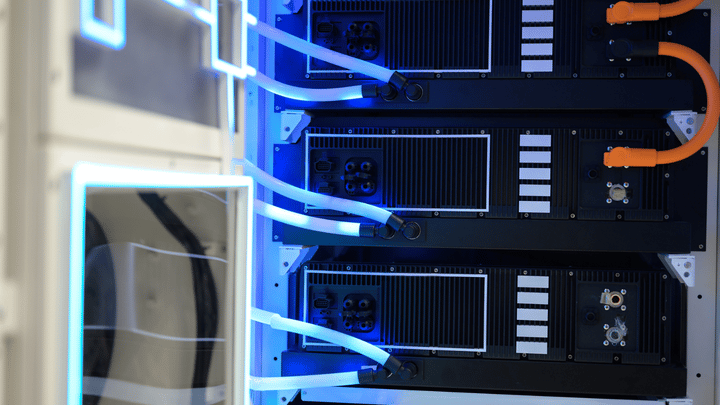
For high-density AI environments, the data center industry has made its decision on liquid cooling. Facilities running dense AI workloads have led the way, and direct-to-chip cooling, in which liquid is routed through cold plates directly onto the processors, is becoming increasingly important in AI-optimized environments..
The question is no longer whether liquid cooling will become more widely deployed. The more important operational question is what accurate, reliable measurement looks like in this new scenario.. Liquid cooling solves a thermal problem.
But operating these systems reliably over time introduces a different set of requirements, and the measurement infrastructure that supports reliable operation is part of that shift.. From One Domain to Two. Running a liquid-cooled facility is not a straightforward extension of running an air-cooled one.
It is a categorically different operational environment, demanding new expertise across power, structural and mechanical engineering, fluid dynamics and chemistry, and instrumentation. And across all of these disciplines, measurement is the layer that makes the environment controllable..
Related:Rethinking the Blind-Mate Connection. In a traditional air-cooled facility, the management of controlled environments is well understood. Temperature, relative humidity, and differential pressure have decades of industry practice behind them, supported by mature sensor technology and standardized guidance such as that published by ASHRAE, the American Society of Heating, Refrigerating and Air-Conditioning Engineers.
Operators know what they are measuring, why they are measuring it, how the information feeds into controls, and what the numbers mean.. Liquid cooling extends that domain significantly. Pipes carrying cold water have always been part of data center infrastructure.
What changes when cooling is brought all the way to the chips through CDUs and cold plates is the scope and criticality of liquid-side measurement.. The parameters that now require dedicated instrumentation include liquid temperature, pressure, flow rate, and level, as well as leak detection and coolant health indicators such as pH, turbidity, conductivity, and refractive index.
Each carries its own failure modes and must be understood in the context of cooling-loop performance and liquid quality.. Liquid cooling takes over where air-side cooling runs out of headroom, but air-side management remains essential for everything else. Direct-to-chip cooling removes heat from the hottest components, but residual heat still needs to be managed with air.
That is why operators need to understand both environments together.. Related:Why AI Data Center Cooling Needs to Get Smarter. Measurements in a Liquid-Cooled Environment.
Alongside the liquid-side parameters, ambient conditions in the data hall and in the critical parts of the cooling system must be actively managed. Dew point is one area where the risk concentrates.. Liquid cooling improves efficiency by circulating cold liquid over the cold plates.
However, colder piping in an air-conditioned space also poses a risk of condensation. When pipe surface temperature drops below the ambient dew point, water can form near equipment, where the consequences of a failure event can far exceed any maintenance budget.. A common practice is to maintain coolant supply temperatures at least 2°C above the measured ambient dew point.
The coolant distribution unit is responsible for maintaining that margin, but only if it has a continuous and accurate picture of the actual dew point.. The measurement challenge across all these parameters is not exotic. It draws on well-established sensor physics.
The greater challenge is applying that physics correctly by understanding where to measure and how sensor data should feed into control decisions.. Dynamic Facilities Demand Dynamic Measurements. AI workloads fundamentally differ from traditional data center workloads in ways that matter for cooling.
AI training jobs are intensive, and AI inferencing is intermittent. A cluster can move from idle to full load in minutes, generating a sharp change in thermal output that the cooling system must respond to in real time.. Related:The Hidden Failure Domain in N+1 Data Center Cooling.
The CDU managing that cluster needs to continuously control the cooling loop, ensuring supply and return temperatures stay within limits, pressure and flow rates remain within tolerance, and the ambient dew point near the cold manifolds stays within tolerance as conditions change.. Reliable measurement is what makes that dynamic control possible.
Without accurate, real-time data on critical parameters across the facility, control systems may be operating on delayed or inaccurate information.. The consequences can cascade. Inefficient cooling wastes energy.
Inadequate cooling puts hardware at risk. Overcorrection can waste energy and reduce operational efficiency.. What the Next Generation Will Require.
Rack densities will continue to increase, and each step in that progression adds measurement requirements that do not yet benefit from decades of established industry practice.. Reliable measurements give operators confidence that both the cooling infrastructure and the compute hardware it supports are operating within safe parameters.
They enable more precise control, help facilities pursue efficiency targets, and provide early warning when conditions begin to drift.. Without trustworthy measurements, a liquid-cooled data center is operating on assumptions.. As cooling architectures become more complex and air-side and liquid-side environments increasingly need to work together, understanding what rigorous measurement looks like in this environment is where the hard work of the next phase begins.