BERLIN – A simple imperative has defined the AI data center boom: faster, bigger, and more powerful.
But that acceleration is also drawing pushback, particularly in the US, where communities are raising concerns about the speed, scale, and sustainability of new data center development.
Nvidia sits at the center of that expansion. The GPU leader is not only supplying much of the technology behind the AI buildout but also helping shape the economics of the next generation of AI-optimized facilities, which it calls AI factories.
A Modular Push for Faster AI Buildouts
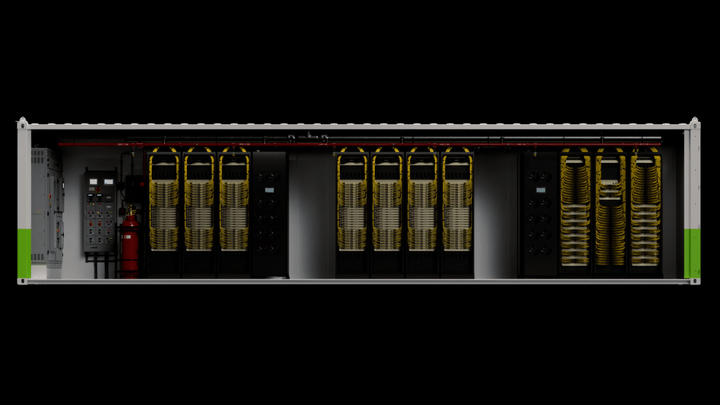
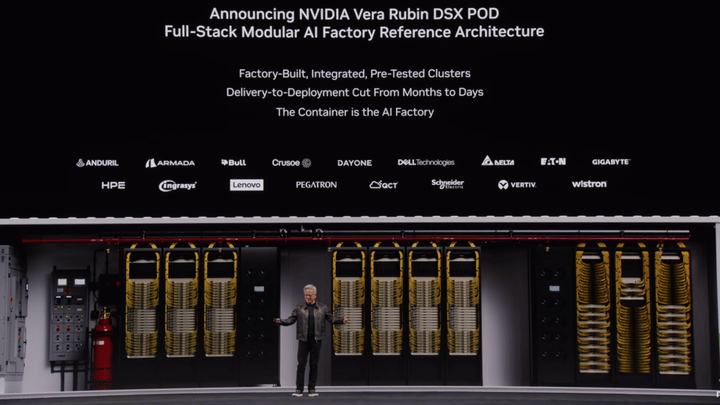
At its GTC event in Berlin, Nvidia unveiled its latest effort to accelerate that growth: a prefabricated modular reference design called DSX POD.
The design is intended to give Nvidia partners, including Dell Technologies, HPE, Schneider Electric, and Vertiv, a standardized blueprint for containerized data centers built around the company’s Vera Rubin AI infrastructure. Nvidia said the factory-built, pre-integrated modules can reduce deployment times from roughly six months to as little as 14 days.
Chief executive Jensen Huang introduced the DSX POD during his keynote, positioning it as a way for operators to bring expensive AI infrastructure online more quickly and begin generating returns sooner.
Huang said that each gigawatt-scale data center costs $50 billion. “The revenue generation you expect is tens of billion dollars per year,” he said. “If delayed by just three months, that’s $10 billion worth of revenues.” By shifting more of the work into the supply chain, he said, the time from installation to production can fall from months to about a month.
Huang described the DSX POD approach as a fundamental change in how data centers are delivered, arguing that shorter deployment cycles would reduce idle computing capacity and unused capital expenditure while improving profitability.
Greenpeace Protest Interrupts Keynote
Shortly before Huang detailed the new design, however, a small group of Greenpeace protesters interrupted the keynote from the audience.
The protesters unfurled a banner and projected a message onto the stage reading “Clean up Your Dirty Business.” They also shouted questions about Nvidia technology reportedly found in Russian drones, as well as the environmental effects of data center expansion. “Jensen, what about the technology that was found in Russian drones?” one protester shouted. “What are you doing about the environmental destruction? What about sustainable energy?”

Protesters held up a banner that read, “Nvidia, clean up your dirty business!” (Image: Andrew Donoghue)
Greenpeace later said it was behind the protest. “While Nvidia is building an unchecked AI empire no one consented to, people are paying the price,” Benjamin Stephan, Big Tech campaigner at Greenpeace International, said in a statement. “Around the world, communities face damage to water supplies and soil, alongside rising electricity bills because of unchecked expansion of data centers.”
Huang remained calm during the interruption and asked security not to overreact as protesters were escorted from the hall. “Everybody has a chance to say something,” he said. “I’ll talk to you later. But let me get through my keynote.”
The protesters’ comments about Russian drone technology referred to reports earlier this year that Nvidia Jetson Orin modules had been found in the wreckage of drones used by Russia’s military. Nvidia has said the products are consumer-grade systems sold to students, developers, and startups.
The protests underscored a broader tension for the industry. While anti-data center demonstrations have become more common, they are typically staged outside venues rather than inside keynote halls.
Brownfield Potential and Deployment Questions
That tension is also relevant to the DSX POD itself. Nvidia says the system uses dry coolers in place of traditional evaporative cooling, which could help address concerns about water use. At the same time, a platform designed to accelerate deployment could intensify opposition in communities already uneasy about how quickly data center projects are moving.
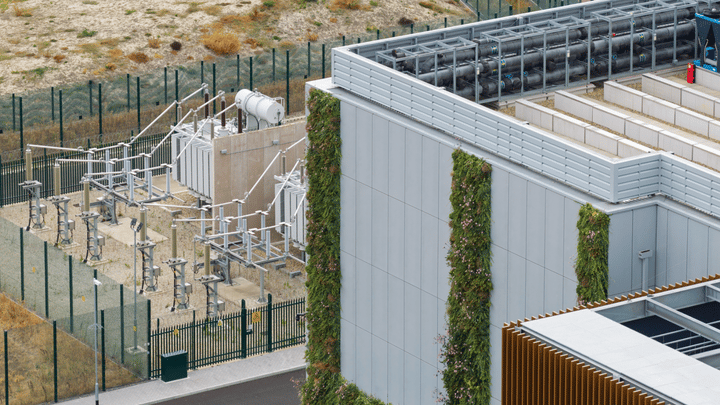
The containerized form factor may prove equally divisive. Critics may see it as a symbol of industrial infrastructure arriving faster and more visibly. Nvidia did share an image of a large data center campus built entirely from DSX PODs, but the company’s vice president of DGX systems, Charlie Boyle, told Data Center Knowledge that the units could be deployed inside existing industrial buildings and brownfield sites, effectively turning disused sites into new data center capacity.
“I have got people putting these effectively in old, abandoned warehouses,” Boyle said. “An old, abandoned building you see every day – suddenly there are lights in there, and it’s now a data center.”
That aligns with the industry’s recent push to reuse brownfield sites and former industrial property. However, recent data from JLL suggests that in parts of Europe, operators are increasingly looking beyond urban centers for larger campus-style developments.
Boyle also argued that the modular design offers flexibility from a sustainability perspective, saying operators could place the units where waste heat might be reused and where the systems can be integrated into a wider site strategy. “You can put these things anywhere. You can grow trees around them,” Boyle said. “That is part of the flexibility of it. You can put it somewhere you can reuse the heat, like next to a swimming pool. You have a lot of options.”
Boyle also pushed back on concerns about upgradability and lifespan of containerized designs, given how closely integrated the power, cooling, and other support systems are to the IT. He suggested customers could deploy newer containers based on the latest Nvidia systems alongside older ones as infrastructure requirements evolve.
Prefabricated modular data centers, including designs based on shipping containers, are not new. Many of the vendors backing Nvidia’s announcement have offered such systems for years. What Nvidia is betting on is that a reference architecture endorsed by the company itself will help standardize deployments and accelerate adoption as operators race to add AI capacity.