Stargate Update: AI’s Biggest Data Center Buildout Meets Reality
.webp?width=100&auto=webp&quality=80&disable=upscale "Picture of Nathan Eddy")
6 Min Read
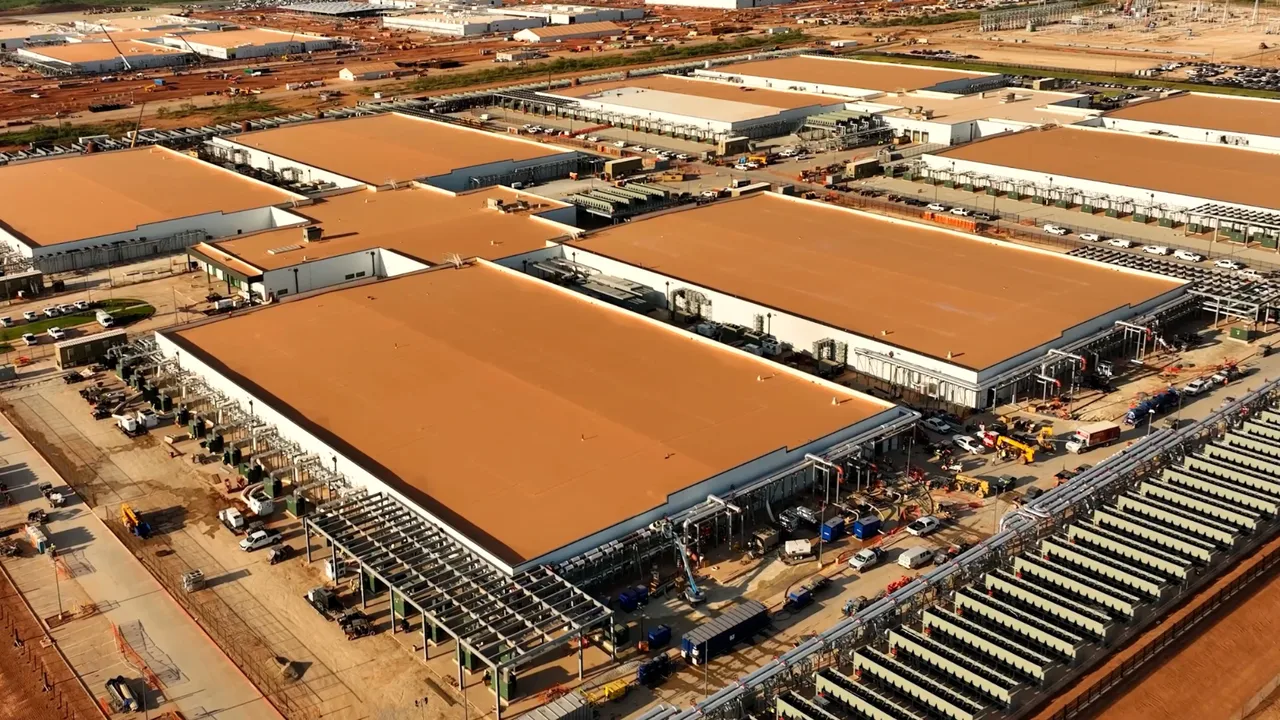
Abilene’s flagship AI data center takes shape at gigawatt scale. OpenAI
Eighteen months after its splashy White House unveiling, Stargate has evolved from a $500 billion promise into a real-world test of whether the AI industry can build infrastructure at a scale never attempted before.
Announced in January 2025 by OpenAI, SoftBank, Oracle, and MGX, the initiative was pitched as the physical foundation for next-generation AI, with plans to deploy up to 10 GW of compute capacity and invest hundreds of billions of dollars in data centers, power systems, and supporting infrastructure across the US.
Stargate has become a prominent proof of concept for building AI like heavy industry, treating compute, power, and capital as a single system. The central question now is whether it can scale faster than the risks that scale creates, across energy, financing, governance, and community consent.

WASHINGTON, DC – OpenAI CEO Sam Altman, accompanied by US President Donald Trump, Oracle co-founder, CTO, and Executive Chairman Larry Ellison (R), and SoftBank CEO Masayoshi Son (2nd-R), speaks during a news conference in the Roosevelt Room of the White House on January 21, 2025, in Washington, DC. (Photo by Andrew Harnik/Getty Images)
A National and Global Footprint Takes Shape
Since its start, Stargate has expanded well beyond its Texas roots. New campuses have been announced in Wisconsin, Ohio, New Mexico, and elsewhere, and international projects have emerged in Abu Dhabi and Norway.
In December 2025, Vantage Data Centers broke ground on its Lighthouse campus in Port Washington, Wisconsin – a $15 billion Stargate-related project that is planned to deliver four data centers totaling 902 MW of IT capacity across 674 acres, featuring closed-loop cooling and other sustainability-focused design elements.

Vantage Data Centers broke ground on the Lighthouse campus in Port Washington, Wisconsin, in December 2025. (Image: Vantage Data Centers/LinkedIn)
Blueprints for Gigawatt-Scale AI Campuses
According to Lilli Flynn, DCByte senior analyst for the Northeast/Mid-Atlantic US, Stargate is increasingly operating as a prototype for gigawatt-scale AI campuses integrated with dedicated energy strategies, rather than a traditional hyperscale data center expansion.
“The combination of behind-the-meter generation, co-located energy infrastructure, and phased GPU deployment reflects a shift toward vertically coordinated ‘AI industrial parks’ rather than standalone data center assets,” she said.
Flynn added that this model is already being adopted across the market, particularly for AI training clusters that require high-density rack power and rapid scaling capability. “Structurally, the project is notable for its unusually broad ecosystem of stakeholders: early-stage equity participation from SoftBank Group, Oracle, OpenAI, and MGX, alongside technology alignment with Nvidia, Microsoft, and Arm,” she said.
That multi-party structure, she explained, helps de-risk capital intensity, secure hardware pipelines, and accelerate interconnection timelines.

A rendering of the Project Jupiter AI data center campus in Doña Ana County, New Mexico. The campus swill serve as the primary southwestern infrastructure hub for the Stargate network. (Image: Oracle)
Financing, Demand, and Partner Friction
Ambition at this scale has brought predictable headwinds: concerns over power consumption, questions about financing, disagreements among partners, shifting relationships with Microsoft, and reports of delays tied to governance and ownership disputes.
Flynn noted that financing and demand certainty are also becoming more tightly coupled than in traditional hyperscale builds. “Unlike cloud infrastructure driven by relatively stable enterprise workloads, AI factories require forward-committed demand visibility that is still evolving,” she said.
“Any revision in training or inference scaling assumptions can materially alter expansion pacing, as seen in the reported adjustment to Abilene’s planned growth.”
Abilene Flagship: Fast Track, Early Lessons
The flagship Stargate site on the outskirts of Abilene, Texas, is a sprawling, 1,100-acre mega-campus. Flynn said the Abilene site has developed on an aggressive construction timeline, progressing from initial groundworks to energization and early deployment of its first buildings faster than most comparable hyperscale AI campuses.
“However, early operations have already highlighted execution risk, with reported weather-related outages following energization underscoring the fragility of rapid-scale grid interconnection in emerging megawatt-class AI campuses,” she said.

A substation that serves the Abilene, Texas, campus. (Image: Oracle)
Texas Policy Headwinds
In parallel, Texas is becoming both a top-tier AI infrastructure destination and a more politically sensitive development environment. Rising scrutiny over water usage, land impact, and grid stress is prompting stronger regulatory signals, including proposed changes to tax incentives and permitting frameworks.
“Governor-level policy discussion around data center incentives and resource consumption suggests that future expansion may face a more conditional approval environment than earlier phases of the boom,” Flynn said.
That evolving policy landscape will shape how quickly – and under what conditions – Stargate can continue to scale in the state.
Will Hyperscale Define the Next Decade?
The Stargate initiative increasingly raises a larger question for the entire AI industry: Will hyperscale AI infrastructure become the dominant blueprint for the next decade of computing, or will economic realities, community opposition, and energy constraints ultimately force a retreat from the era of trillion-dollar AI buildouts?
John Dinsdale, chief analyst and research director, Synergy Research Group, told Data Center Knowledge that he sees nothing inherently wrong with Stargate-type initiatives. “Planning and developing gigawatt campuses is now fairly commonplace – for hyperscale cloud providers, Meta, and some of the neoclouds,” he said. “The key is in the companies involved planning carefully, having reasonable objectives, and then following up with operational excellence.”
Assuming careful site selection and secure power, Dinsdale added that funding and ongoing financial performance are the main challenges. “Projects need to be financially strong and have patient backers,” he said. “Payback is not going to be quick.”
While construction continues, parts of the originally announced expansion tied to OpenAI and Oracle were reportedly scaled back in March 2026 amid financing complexity and revised demand assumptions, said Alexandra Desseyn, Americas research manager for DCByte, in an interview with Data Center Knowledge. “Although Oracle publicly denied any setbacks and reaffirmed the site remains on track, the divergence in messaging reflects broader uncertainty around sequencing of AI infrastructure relative to GPU availability and demand certainty,” she said.
Desseyn added that Microsoft’s entry, through its partnership with Crusoe to develop additional buildings at the same site, suggests the project is evolving from a single-anchor deployment into a more multi-tenant AI infrastructure hub.
“This could potentially mitigate some demand concentration risk but also complicate governance and long-term capacity planning,” Desseyn said.
About the Author