
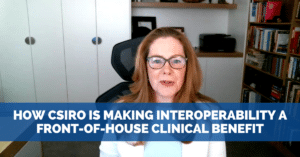
Healthcare interoperability is seen as a back-office challenge and it is rarely spoken about as a benefit to clinicians. But what if it was? Could it help accelerate initiatives?.
An initiative in Australia is doing just that. They’re using free and seamless data exchange to reduce screen time so that clinicians can focus more on conversations with patients.. Healthcare IT Today sat down with Kirsty Maunder, Senior Business Analyst at CSIRO’s Australian e-Health Research Centre.
We discussed their Smart Health Checks initiative, which uses Smart on FHIR technology to reduce data entry and foster human connection at the heart of care.. Key Takeaways. Make interoperability a front-of-house benefit.
Pre-populating health checks eliminates screen time and allows a clinicians to focus on having a natural conversation with their patient to gather important information.. Smart forms prevent manual transcription errors. By writing data directly back to the clinical information system, it pushes updates directly into downstream pathways for better chronic disease management and national reporting..
Address daily frustrations of your clinical staff. The push for a smart form did not start as a technology mandate, but evolved naturally from workshops where community groups expressed frustration over repeated data collection.. [embedded content]. Making Interoperability a Front-of-House Benefit.
Clinicians spend too much time staring at screens instead of speaking with patients. The Smart Health Checks project by the Australian e-Health Research Centre addresses this by auto-filling digital templates with existing patient data before the visit even begins. This frees the provider to engage in what Aboriginal and Torres Strait Islander communities call “yarning”, which is a natural conversational flow..
Maunder explained the goal clearly: “By pre-populating as much data as possible and then [allowing the clinician to] really focusing on listening, it expediates the process for the clinician and offers a better experience for the patient”.. Eliminating Transcription Errors with Write-Back Capabilities.
Data capture only matters if the information flows easily to the next step of care. Forcing a clinician to re-key data guarantees transcription errors and wastes valuable time. The CSIRO team made sure to eliminate this by ensuring their smart forms communicate in both directions..
“The other thing that a SMART Form can do is it can write back to the clinical information system,” Maunder noted. “All of that information that pre-populated, you can update or add new information, and it’ll write back to the clinical information system so you are able to use it for downstream pathways such as e-referrals, chronic condition management plan, national key performance indicator reporting.”.
Building Solutions from Clinical Frustrations. Most successful IT projects start with listening to the people doing the work. CSIRO did not launch their Smart Health Checks initiative because of a government mandate.
It was in response to real pain points raised by Australian health organizations. Maunder pointed out that the idea grew from community workshops.. The Bottom Line.
Data standards and interoperability are often dismissed as back-office IT concerns. For decades, true data liquidity has remained an elusive goal. It is time to tie data exchange directly to clinical and administrative relief in order to accelerate adoption.
The Smart Health Checks initiative in Australia shows what happens when interoperability is baked into tools doctors actually want to use.. Questions Healthcare IT Leaders Are Asking. How does SMART on FHIR improve the patient encounter?.
SMART on FHIR applications can extract existing data from the electronic health record to pre-populate clinical forms. This automation prevents clinicians from re-typing known information. As a result, the provider spends less time looking at a monitor and more time engaging directly with the patient..
Why is data write-back critical for clinical workflows?. Write-back functionality allows a third-party application or smart form to push new data directly into the core clinical information system. This eliminates manual transcription errors and ensures the patient record updates immediately.
It also accelerates downstream workflows like chronic disease management plans and national quality reporting.. How should IT leaders identify which clinical workflows to digitize?. The best digital tools originate from the daily frustrations of front-line staff.
IT teams must conduct collaborative workshops to identify operational pain points, such as redundant data entry and fragmented templates. Addressing those specific barriers directly leads to faster user buy-in and higher adoption rates.. Why is interoperability especially critical in markets like Australia?.
Unlike environments dominated by one or two giant enterprise electronic health records, Australia’s healthcare landscape features a wide variety of independent primary care systems, allied health applications, and regional point solutions. Because providers do not share a single monolithic software platform, open standards like HL7 FHIR and SMART forms are essential to bridge these separate systems, prevent repeated data collection, and ensure continuity of care across disparate providers..
Learn more about CSIRO’s Australian e-Health Research Centre at https://aehrc.csiro.au/. Listen and subscribe to the Healthcare IT Today Interviews Podcast to hear all the latest insights from experts in healthcare IT.. And for an exclusive look at our top stories, subscribe to our newsletter and YouTube..
Tell us what you think. Contact us here or on Twitter at @hcitoday. And if you’re interested in advertising with us, check out our various advertising packages and request our Media Kit.. .
Get Fresh Healthcare & IT Stories Delivered Daily. Join thousands of your healthcare & HealthIT peers who subscribe to our daily newsletter.. We respect your privacy and will never sell or give out your contact information