
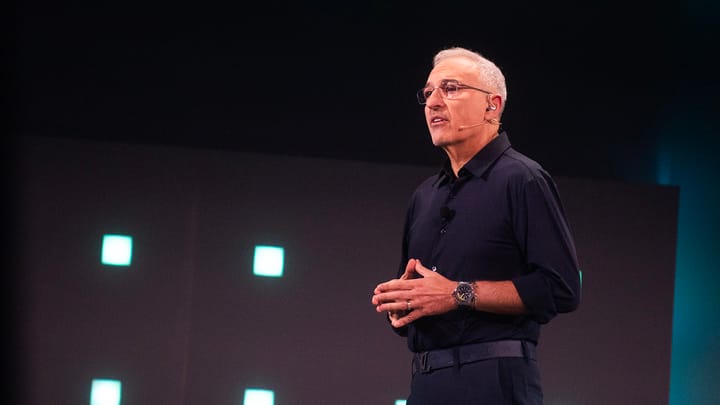
LAS VEGAS – HPE CEO Antonio Neri used his Discover 2026 keynote on Tuesday to position networking as the foundation of the AI era, unveiling Juniper-powered AI networking updates, expanded private AI offerings, and a broader vision he called the “agentic enterprise.”
The event is HPE’s first Discover following its $14 billion acquisition of Juniper Networks. Nearly every major announcement – from AI fabrics and data center interconnects to GreenLake automation and “self-driving” network operations – tied back to a central theme: networking is becoming the control plane for AI infrastructure, the company said.
“There is always one core element of your infrastructure that touches everything,” Neri said. “That core element is the network.”
Why HPE Bought Juniper: Neri’s Rationale
The networking focus carried into a media Q&A following the keynote, where Neri offered his clearest explanation yet for HPE’s acquisition of Juniper.
When Data Center Knowledge asked why HPE pursued a deal of that size after years of building its networking business organically, Neri said the company concluded that AI and cloud computing were reshaping the role of networking.
“As cloud and AI grew, we learned very quickly that the next big opportunity and the next big frontier of innovation was networking,” Neri said.
While GPUs have dominated much of the AI infrastructure conversation, Neri argued that networking remains one of the industry’s most important challenges because it has not advanced as quickly as compute.
“The networking layer of the stack is going to be the next opportunity,” he said.
Neri described the integration as one of HPE’s smoothest large-scale acquisitions, citing the rapid integration of engineering teams, unified product roadmaps, and a steady cadence of networking product launches since the deal closed.
“Every byte, every token, every decision crosses the network,” Neri said.

Antonio Neri speaks during a press Q&A at HPE Discover 2026 in Las Vegas. (Photo by Shane Snider)
Juniper Takes Center Stage in AI Networking
HPE highlighted Juniper-based networking products positioned for AI training and inference environments, including the QFX5220 switch for large-scale AI clusters and the QFX5130 platform for distributed inference deployments. Neri also outlined plans to integrate Juniper networking into HPE’s AI factory architecture, extending the networking stack from training clusters to data center interconnects and distributed enterprise environments.
Industry analysts said the keynote represented HPE’s clearest articulation of how Juniper fits into its long-term AI strategy.
“I think HPE is very definitely now a networking company,” said Steven Dickens, CEO and principal analyst at HyperFrame Research. “We saw really clearly that networking is a core tenet of the company.”
Ron Westfall, vice president and practice lead for networking and infrastructure at HyperFrame Research, said HPE’s ability to combine networking, compute, storage, and cloud technologies could become a differentiator as enterprises move from AI experimentation to production deployments. “It’s a way for HPE to sharply define a strategic vision while also demonstrating portfolio-wide competitive advantages,” he added.
Westfall noted that the acquisition was intended to create tighter integration between networking and compute infrastructure. “One of the prime reasons for acquiring Juniper was to have a compelling vision that combines the compute and networking sides into one solution set,” he said.
The integration effort appears to be progressing smoothly, according to Dickens.
“We’ve seen a lot of acquisitions at that scale fail because of the egos in the boardroom,” Dickens said. “Antonio has done a really good job of executing on that.”
Building the “Agentic Enterprise”: Governance for AI at Scale
Beyond networking, Neri spent significant time outlining HPE’s vision for enterprises operating large numbers of AI agents. The company announced updates to its Private Cloud AI platform, adding governance, security, and operational management capabilities for agent-based systems across enterprise environments. New features include agent registration, identity controls, and policy enforcement, as well as integrations with Nvidia software intended to help enterprises manage AI systems operating across corporate data and applications.
“IT will be responsible for thousands of agents that are part of your enterprise workforce,” Neri said, framing the agent lifecycle as a core operational concern.
HPE also expanded Private Cloud AI configurations and introduced new capabilities, aiming to move AI projects from pilots to production while maintaining security and operational control.
GreenLake Intelligence Pushes Toward Autonomous Operations
HPE said it is expanding GreenLake Intelligence, an initiative that embeds generative AI and AI agents into infrastructure operations. According to the company, the platform analyzes telemetry across networking, cloud, storage, and compute to identify issues, recommend actions, and automate tasks. It is being integrated into Aruba Central and other GreenLake services to assist with network operations, virtual machine migrations, capacity planning, and troubleshooting.
Data Center Power Limits and AI Growth
While networking dominated the keynote, Neri emphasized power availability as a defining constraint on AI growth.
“At its core, an AI factory is doing one thing: turning electrons into tokens,” Neri said.
During the media Q&A, he noted that large AI developers are increasingly investing directly in energy infrastructure to secure power for future deployments. He pointed to innovation in power generation, transmission, cooling, and server efficiency.
HPE highlighted work with Siemens Energy, which is using HPE infrastructure and AI tools to accelerate engineering, design, and grid-related projects.
The focus reflects growing concern that power, not compute, could become the primary constraint on AI deployments.