
Google has announced a new open-source rack-mounted, closed-loop liquid-to-air cooling system for use in existing air-cooled environments.
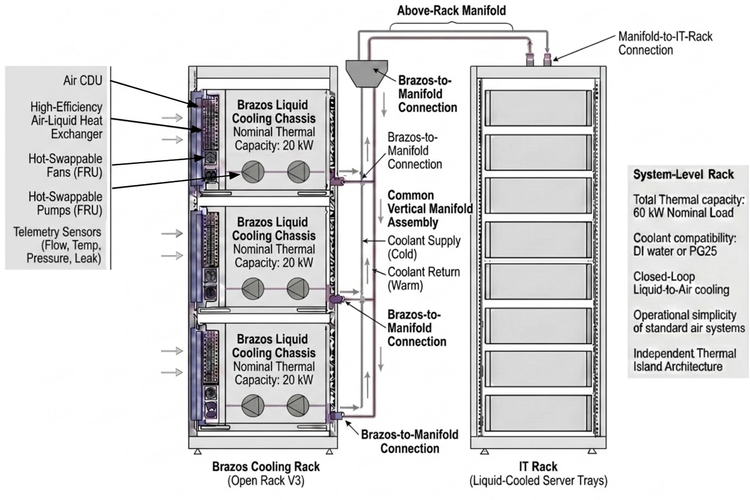
The new system, dubbed Brazos, is designed to allow one-at-a-time installation of high density, liquid cooling equipment.

Brazos is already generally available. Google said its manufacturing suppliers are “ready to engage the broader industry to market and produce the Google Brazos design.”
Google said Brazos will allow high-performance liquid cooling with the operational simplicity of standard air systems.
The system is self-contained and works by capturing heat via liquid at the component level, then rejecting it into the data center’s hot aisle using liquid-to-air heat exchangers.
It is modular, including three cooling units and integrated rack manifolds. Each chassis will occupy 11 Open Units of rack height and interfaces with standard Open Compute Project ORv3 form-factor racks.
Brazos supports a 60kW nominal thermal load per rack across three modular units and is compatible with either deionized water or a 25 percent propylene glycol mixture. It operates on a 40-60V DC input, connecting directly with standard rack busbars.
Google said it is certified to UL/CSA/IEC 62368-1 standards and has built-in leak detection and pressure relief valves.
It also features a built-in human-machine interface with remote management connecting via Modbus over TCP.
Google said it intends to open-source the technical specifications, design principles and visual assets of Brazos.
“As part of a broader infrastructure portfolio that continues to leverage waterless air-cooled systems alongside liquid cooling, Brazos represents one of many innovations we are contributing to the open hardware ecosystem,” Google said in a blog post.
“We invite system architects, manufacturers, and thermal engineers to evaluate these designs to scale rack-mounted cooling infrastructure for the high-power computing demands of the future.”
With Brazos, Google is expanding on open-source density adaptations to rack power and cooling designs. These upgrades are driven by the requirements of AI on rack power densities, which has proved complex to implement for both new developments and retrofits.
In 2024, Microsoft and Meta announced Mount Diablo, an open rack design for AI data centers which separates power and compute into different cabinets, aimed at tackling the same issue. Rather than having both elements in the same rack, the power cabinet operates as a sidecar unit with the main rack space dedicated to compute.
Google has also been involved in Mount Diablo as part of the Open Compute Project, contributing to the standardization of electrical and mechanical interfaces and developing, along with Meta and Microsoft, an AC-to-DC sidecar power rack to allow the main rack space to be used for GPUs, TPUs, and CPUs. Longer term, Google said it was exploring direct distribution of higher-voltage DC power within the data center and to the rack.
Amazon Web Services (AWS) has also explored custom liquid cooling solutions using a similar sidecar design. Dubbed the In Row Heat Exchanger, AWS’ design can be similarly installed without adjusting air-cooled mechanical designs.
More in Cooling

More in Cloud & Hyperscale