As AI and HPC continue to reshape the digital landscape, rack densities are rising rapidly, driving data center infrastructure into uncharted thermal territory.. As a result, pumped two-phase cooling is evolving from a promising lab concept into a practical technology being deployed at scale.
As these systems move into production environments, the focus is shifting from the principle of liquid cooling itself to the actual journey of the refrigerant through the system.. Every stage of this migration must be carefully controlled. Unlike single-phase cooling, where the fluid remains in one state throughout the loop, two-phase systems rely on the precise management of pressure, temperature, and phase change to deliver consistent thermal performance..
In this DCD>Broadcast episode, experts from Parker, a global leader in motion and control technologies, examine the often-overlooked parts of that journey – the tubing and hose assemblies that transport refrigerant between manifolds and cold plates. While these components may appear straightforward, they are critical to maintaining refrigerant charge stability, flow distribution, uptime, and serviceability – all without requiring a complete redesign of rack architecture..
Following the refrigerant through a two-phase cooling loop. Rack power is rapidly surpassing the traditional 20-40kW range to well over 100kW, forcing data center cooling architectures to evolve to accommodate these higher heat loads.. Modern liquid-cooled racks rely on integrated manifolds, hose harnesses, refrigerant distribution units (RDUs), and coolant distribution units (CDUs) to deliver refrigerant precisely where it is needed..
You need to be sure that you’re looking at two-phase cooling solutions that are specifically designed and tested for these applications Josh Coe, Parker. “You need to be sure that you’re looking at two-phase cooling solutions that are specifically designed and tested for these applications,” says Josh Coe, market manager for Parker’s Parflex division..
Walking through a typical two-phase cooling architecture, Coe explains how refrigerant is supplied from an overhead manifold into an RDU or CDU before being distributed through a rack manifold. From there, subcooled liquid refrigerant is delivered via jumper hoses directly to the cold plates installed over high-power processors..
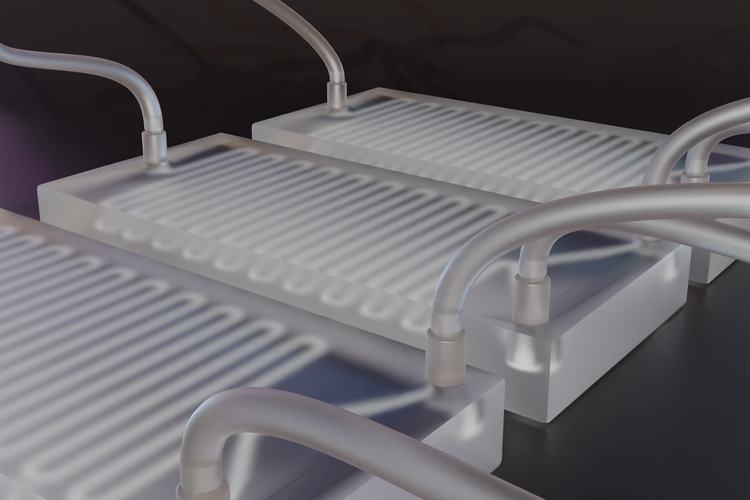
Once the refrigerant reaches the cold plate, it absorbs heat from the CPU, GPU, or other high-power components. As it does so, it begins to boil, changing into a controlled liquid-vapor mixture. This phase change removes large amounts of heat while keeping chip temperatures within their operating limits, before being condensed back into liquid for recirculation..
“One of the key things with refrigerant systems is you don’t want to have what’s termed a dry-out, where you convert all of the liquid to gas,” explains Lee Beitzel, senior product engineer, Parflex Division, Parker, adding:. “That can drastically affect the efficiency of the system and create nuances with pressure changes or pressure drops, which you do not want to have as it crosses over the cold plate.”.
That can drastically affect the efficiency of the system and create nuances with pressure changes or pressure drops, which you do not want to have as it crosses over the cold plate Lee Beitzel, Parker. Maintaining the correct vapor quality at the cold plate outlet is therefore essential.
Rather than allowing the refrigerant to boil completely into vapor, engineers aim to ensure a precise portion of the liquid remains in the mixture, enabling it to be pumped efficiently back through the condenser and reservoir while maintaining stable pressure, balanced flow, and optimal cooling performance.. Selecting the right refrigerant.
Material compatibility is a decisive consideration in any refrigerant-based cooling system. Different refrigerants interact with tubing and component materials in different ways, making compatibility testing essential for long-term reliability.. As our Parker experts explain, two-phase cooling refrigerant selection is not driven by heat transfer performance alone.
The optimal fluid must balance thermal effectiveness, operating pressure, material compatibility, safety, environmental profile, and overall system design to support scalable, reliable cooling for next-generation AI infrastructure.. During the broadcast, Beitzel highlights two refrigerants that are attracting attention in data center cooling applications: R1233ZD(e) and R-515B.
Both belong to a newer generation of refrigerants designed to deliver efficient two-phase heat transfer while offering significantly improved environmental characteristics compared with legacy refrigerants.. One of the leading items to consider when picking refrigerants is thermal effectiveness.
By exploiting the latent heat absorbed during the liquid-to-vapor phase change, two-phase refrigerants can remove substantially more heat than conventional single-phase water or glycol cooling loops, enabling much higher cooling densities.. Beyond heat transfer, refrigerants must also be chemically stable, non-corrosive, and compatible with seals, hoses, tubing, and other materials used throughout the cooling loop..
R1233ZD(e) and R-515B both exhibit strong thermal properties while offering low toxicity, good material compatibility, and low environmental impact, although each presents its own engineering trade-offs depending on the application’s operating temperatures, pressures, and system architecture.. With the possibilities for material compatibility far-ranging, the good news is that most refrigerants have been looked at from an ecological perspective for some time:.
“In the data center market, really nothing’s being looked at that does not have a good environmental profile, so most of these refrigerants have a low effect on the ozone and have a very low global warming potential,” explains Beitzel.. As overall sustainability considerations continue to influence infrastructure design, refrigerant selection is increasingly becoming a system-level engineering decision.
Precisely manufacturing these materials to interact with their infrastructural counterparts across the system is crucial to balancing cooling performance, reliability, regulatory compliance, and environmental responsibility.. How tubing geometry influences two-phase cooling performance.
Beyond material selection, the physical design of the fluid conveyance system – tubing diameter, routing, and length – has a direct impact on refrigerant flow stability and overall cooling performance.. As the refrigerant travels through the system, engineers must carefully manage both flow rate and pressure to ensure the fluid reaches and leaves the cold plate under the right conditions..
“You want to have as level a pressure as possible to increase the efficiency of the heat carried away during the phase change,” says Beitzel.. That requirement becomes particularly important as the refrigerant changes state. Entering the cold plate as liquid, the refrigerant occupies a relatively small volume.
As heat is absorbed and boiling begins, however, the liquid expands into its two-phase mixture, significantly increasing its volumetric flow. As Beitzel explains:. “The difference in tubing or hose routings can affect the flow characteristics in a system.
Typically, you’re going to see a smaller inlet diameter and then a larger outlet diameter. As the refrigerants begin to boil and flow drastically increases, that needs to be compensated with a larger inner diameter on the exit.”. Keeping pressure as constant as possible across the cold plate minimizes unwanted pressure drops and helps maintain the target vapor quality at the outlet.
That remaining liquid fraction is critical – not only for efficient heat transfer across the cold plate, but also for ensuring the refrigerant can be pumped effectively back to the condenser and reservoir for the next cooling cycle.. Why low-permeation tubing is essential for maintaining long-term refrigerant stability.
Designing a two-phase cooling system demands careful attention to every element of the refrigerant loop. Unlike single-phase cooling, where pressure losses can often be offset by increasing pump power, two-phase systems require precise control of flow, pressure, and refrigerant charge from the outset..
This refrigerant charge – the exact amount of fluid put into the cooling system to absorb heat – is absolutely critical in preventing the equipment from losing cooling power and wasting energy. The design of the tubing, connectors, and fluid conveyance network therefore becomes fundamental to both system performance and long-term reliability..
Unlike single-phase systems, adding additional horsepower to overcome pressure losses really isn’t an option. You really need to design the system correctly from the ground up Steve Powell, Parker. “Unlike single-phase systems, adding additional horsepower to overcome pressure losses really isn’t an option.
You really need to design the system correctly from the ground up,” says Steve Powell, business development manager, Parflex Division, Parker.. Beyond preventing leaks at connection points, two-phase systems must also contend with permeation – the gradual migration of refrigerant molecules through hose and tubing materials over time.
Even small permeation losses can alter refrigerant charge, impacting system efficiency, increasing maintenance requirements, and raising environmental concerns over the lifetime of the installation. Powell explains:. “Permeation losses must be considered with respect to total cost of ownership and environmental impact, unlike single-phase, and you really want to focus in and select products that are designed and validated for two-phase systems.”.
For that reason, product dimensions, connector design, and ease of installation all play an important role in ensuring a robust, serviceable cooling loop.. Discussing the performance of different barrier-layer technologies, Powell explains that each material presents trade-offs in permeation resistance, moisture absorption, bondability, and mechanical toughness..
While materials are often classified as offering ultra-low, enhanced, or near-zero permeation, the cumulative impact becomes significant when deployed at data center scale. Powell estimates that a typical installation could contain between 600 and 750 meters of refrigerant tubing:.
“When you have that amount of refrigerant flowing through your systems, when looking at the ultra-low rating, you would have close to 30 kilograms of coolant loss per year within your data center. The enhanced or near-zero permeation rates cut those losses in half or by 90 percent, respectively.”.
Reducing permeation therefore isn’t simply about preserving refrigerant – it directly affects total cost of ownership, maintenance intervals, environmental performance, and regulatory compliance. Designing for low permeation from the outset allows operators to better maintain refrigerant charge and consistent cooling performance throughout the system’s lifetime..
Examining traditional installation and operation performance. The installation of cooling infrastructure itself can make or break the success of even the most advanced materials and equipment. Powell stresses that designers must optimize installation practices to minimize residual stresses created during installation, as excessive strain between components or within cable trays can lead to fatigue, cracking, or premature failure after years of thermal cycling and maintenance..
Copper tubing has long been the incumbent choice in HVAC applications, thanks to its zero permeation, proven supply chain, and ease of installation. However, Powell notes that as liquid cooling systems become denser and require more and more manifold connections, copper’s limitations are becoming more apparent:.
“We’re seeing poor yields as people are scaling up for mass production, and the material itself has poor fatigue resistance. So if you’re expecting to do multiple maintenance on these products over the life of their installation, you might want to consider something else.”.
One alternative is engineered thermoplastic tubing and hose assemblies. These offer flex fatigue resistance, reduce residual installation stresses, and can be thermally formed to accommodate compact, high-density routing.. While thermoplastics do exhibit some refrigerant permeation compared with copper, advances in low-permeation hose technologies are enabling designers to balance flexibility with serviceability and long-term charge retention – particularly in the short jumper assemblies increasingly used in AI-ready liquid-cooled racks..
Best practices for tubing design, specification, and integration. To address the wide range of requirements for increasingly dense and high-stakes thermal environments, Parker has developed a portfolio of fluid conveyance technologies specifically for liquid-cooled data centers, where low permeation, minimal pressure drop, and high reliability are all critical.
The portfolio includes:. SP2P thermoplastic coolant tubing: Designed to address demanding routing, safety, and fluid containment requirements in compact system designs (with low permeation performance of less than 1.5kg/m2/year to help reduce fluid loss in coolant loop applications).
285 hose: A dependable refrigerant hose engineered for consistent pressure performance, durability, and specification compliance for high-demand environments. Refrigerant quick thread (RQT) couplings: Deliver hand-tight, self-sealing performance that reduces connection time by more than 70 percent versus traditional connectors while optimizing flow and reducing pressure drop.
A suite of custom-molded, press-in-place, cure-in-place, and other sealing products.. While many of the materials and technologies used for cooling systems are well-established in industrial applications, Coe argues that the real innovation lies in adapting and optimizing them for the unique demands of AI-ready data center infrastructure, where maintaining refrigerant quality throughout its journey is essential to long-term system performance..
From refrigerant selection and phase change within the cold plate to tubing geometry, pressure management, permeation control, and material compatibility, each element contributes to maintaining a stable, efficient cooling loop.. As AI workloads continue to drive ever-higher rack densities, success in two-phase cooling will increasingly depend not on any single component, but on understanding the complete refrigerant path – and designing every part of that journey to work as one integrated system..
Visit parker.com/data-center for more information.